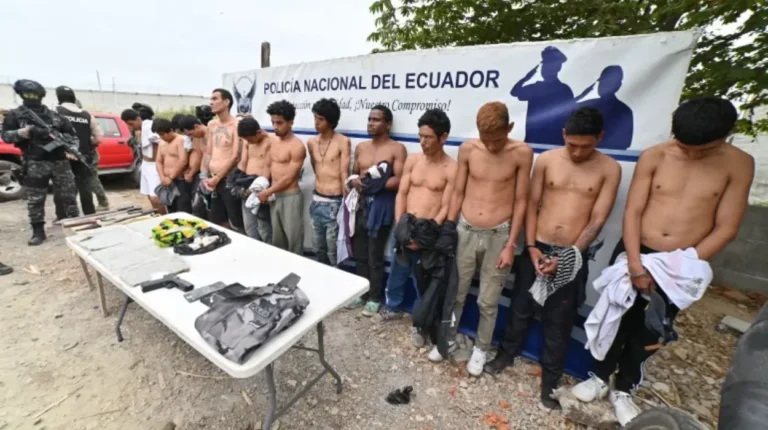
Ecuador’s transformation from one of the safer countries in Latin America into a major security hotspot between 2021 and 2025 reshaped regional threat assessments. Surging homicide rates, cartel conflicts and repeated prison violence created pressure on the government to seek stronger international cooperation. Within that environment, the detention in Quito of a foreign national associated with a U.S. terrorism watchlist brought renewed attention to a concept increasingly discussed in policy circles: Hezbollah in the Andes.
Security officials in both Quito and Washington interpreted the case not simply as a criminal investigation but as part of a broader pattern linking transnational crime networks with actors connected to Middle Eastern militant organizations. Ecuador’s geographic role in the Pacific cocaine corridor has elevated its strategic importance, particularly as drug trafficking routes toward Europe expanded significantly through 2024 and 2025. As a result, policymakers began examining whether financial or logistical networks historically tied to Hezbollah could intersect with the country’s rapidly evolving criminal ecosystem.
The framing reflects a broader shift in how Latin American instability is being analyzed internationally. Domestic crime crises are no longer viewed solely through law enforcement lenses but increasingly through hybrid security frameworks that combine counter-narcotics, financial intelligence and counterterrorism approaches.
Security deterioration and external partnerships
Ecuador’s government expanded cooperation with foreign partners during 2024 and 2025 as violence intensified. Agreements covering intelligence sharing, port security and financial monitoring reflected the belief that local institutions required external expertise and technological support. U.S. officials described the collaboration as part of a wider effort to strengthen regional resilience against organized crime and illicit finance networks that may overlap with sanctioned entities.
For Washington, Ecuador’s instability created both concern and opportunity. The country’s strategic ports and trade routes positioned it as a focal point for monitoring how criminal economies might intersect with global security threats. Analysts argue that this convergence is central to understanding why Ecuador has emerged as a potential testing ground for updated counterterror strategies.
Regional context shaping the narrative
The notion of Hezbollah in the Andes also reflects longstanding U.S. attention to suspected Hezbollah-linked financial activity in the Western Hemisphere. Historically, investigations focused on the Tri-Border Area shared by Paraguay, Brazil and Argentina. However, by 2025, security analysts increasingly emphasized new transit hubs connected to global drug flows, particularly along the Pacific coast.
This shift coincided with broader geopolitical tensions involving Iran and its regional partners, which reinforced scrutiny of any networks potentially connected to Hezbollah abroad. Even when cases revolve primarily around financial activity rather than operational militancy, the perception of linkage influences diplomatic and security responses.
Legacy networks and the reappearance of transnational connections
Investigations into Hezbollah in the Andes often refer to earlier law enforcement cases in Ecuador and neighboring countries that examined alleged links between local criminal enterprises and individuals tied to Middle Eastern networks. Some of these investigations during the 2000s involved businesses suspected of facilitating money laundering linked to drug trafficking revenues.
Historical precedents in Ecuador
Authorities in Ecuador dismantled several trafficking structures in previous decades that highlighted how international actors could use legitimate commercial fronts to move funds and goods. Those earlier cases became reference points for intelligence agencies studying how militant organizations might benefit indirectly from criminal economies in Latin America.
The reappearance of individuals or networks connected to earlier investigations suggests continuity rather than sudden emergence. Experts frequently note that such structures rarely disappear entirely. Instead, they fragment and remain dormant until political instability or economic opportunity allows them to resurface.
Adaptation within criminal ecosystems
The evolution of Ecuador’s drug trafficking landscape has created conditions that external actors could potentially exploit. Ports such as Guayaquil became increasingly central to cocaine shipments bound for Europe, particularly after enforcement pressure intensified in other regions. By 2025, European agencies reported rising seizures linked to routes originating in Ecuador.
These dynamics blur the boundaries between organized crime and transnational security threats. Analysts emphasize that networks focused primarily on financial gain may still intersect with actors under terrorism sanctions, especially when illicit profits move through global financial channels.
Analytical debate over operational presence
One ongoing question within intelligence circles concerns whether Hezbollah-linked actors in Latin America function mainly as financial facilitators or whether any operational structures exist. Most available evidence historically points to fundraising, logistics and money laundering rather than direct militant planning.
Still, the possibility of convergence with local cartels complicates the analysis. Even limited logistical connections can elevate a case’s strategic importance for governments seeking to prevent the establishment of deeper networks.
Legal designations and Ecuador’s policy shift
Ecuador’s decision during 2024 and 2025 to designate Hezbollah and Hamas as terrorist organizations represented a significant policy shift. The move aligned the country more closely with U.S. and some European classifications, creating new legal tools for prosecutors and financial regulators.
Implications for investigations and intelligence sharing
Legal designation enables authorities to pursue cases using counterterrorism statutes rather than relying solely on organized crime laws. This includes expanded surveillance powers, asset freezes and greater coordination with international partners. Ecuadorian officials indicated that aligning definitions with major allies would facilitate faster intelligence exchanges and improve enforcement capabilities.
The policy shift also reflects broader regional trends. Several Latin American governments began reassessing legal frameworks dealing with terrorism financing and illicit financial flows as part of reforms discussed in 2025 security dialogues.
Domestic debates and political considerations
Despite its operational advantages, the designation sparked debate within Ecuador about proportionality and political implications. Some analysts warned that terrorism classifications should be applied carefully to avoid conflating diaspora communities or legitimate businesses with security threats.
Balancing these concerns remains important as Ecuador integrates counterterror tools into a broader campaign against cartel violence and corruption.
U.S. counterterror priorities evolving in the hemisphere
From Washington’s perspective, developments in Ecuador illustrate how counterterror priorities in the Western Hemisphere have evolved. Earlier strategies focused heavily on specific geographic hotspots, but recent assessments increasingly emphasize functional vulnerabilities such as illicit finance, port infrastructure and corruption networks.
Hybrid threat frameworks gaining traction
U.S. security agencies now frequently discuss hybrid threats that combine organized crime, state influence operations and extremist financing. The concept of Hezbollah in the Andes fits into this framework by highlighting potential overlaps between drug trafficking revenue streams and networks linked to sanctioned organizations.
By 2025, policy discussions in Washington underscored the need to integrate counterterror and counter-narcotics efforts more closely, particularly in regions where criminal and political actors interact within fragile institutional environments.
Expanding bilateral cooperation
Security cooperation between Ecuador and the United States expanded during the period of escalating violence. Joint initiatives included training programs, intelligence coordination and financial monitoring systems designed to track illicit transactions linked to trafficking networks.
The arrest of an individual on a U.S. terror watchlist demonstrated how these mechanisms can function in practice. Information sharing enabled authorities to act quickly, reinforcing the perception that deeper cooperation can produce operational results.
Regional signaling and deterrence dynamics
Cases associated with Hezbollah in the Andes also carry broader regional implications. Publicized arrests or investigations signal to criminal intermediaries and financial facilitators that international monitoring has intensified across Latin America.
Message to transnational networks
Such cases indicate that jurisdictions once considered peripheral to global counterterror efforts are now receiving greater attention. The deterrent effect may extend beyond Ecuador by encouraging financial institutions and businesses across the region to scrutinize transactions more carefully.
Risks of overgeneralization
At the same time, policymakers remain cautious about applying sweeping narratives to complex security environments. Analysts frequently emphasize that not every illicit network with international connections should automatically be framed within a counterterror context.
Maintaining analytical precision is crucial to ensuring that law enforcement resources remain focused on verifiable threats rather than generalized suspicions.
Latin America’s shifting security landscape
The emergence of Ecuador as a case study reflects wider changes across Latin America’s security architecture. Governments increasingly view organized crime through a transnational lens influenced by global economic flows and geopolitical rivalries.
During 2025, several countries strengthened anti-money laundering regulations and port surveillance systems, recognizing that illicit supply chains linking South America, Europe and Asia create opportunities for diverse actors. Ecuador’s experience demonstrates how domestic instability can accelerate integration into international security frameworks.
For regional policymakers, the debate surrounding Hezbollah in the Andes highlights the need to address structural drivers of violence while also monitoring external connections. The balance between these priorities will shape how Latin American governments cooperate with major powers and multilateral organizations in the coming years.
Ecuador’s evolving role suggests that modern counterterror policy increasingly unfolds in environments where organized crime, economic globalization and geopolitical competition intersect. Whether the concept of Hezbollah in the Andes remains a narrowly defined analytical tool or grows into a broader regional security framework will depend on future investigations, policy decisions and the complex realities unfolding along the Andean corridor.