Signing off on April 26, 2026, while Ukraine observed the 40th anniversary of the Chernobyl nuclear disaster in a dignified way, President Volodymyr Zelensky posted an unrestrained condemnation of Russia, calling it “nuclear terrorism”. In conjunction with new, recent catastrophic Russian drone attacks against Ukraine, this allegation supports the notion that historical disaster and present-day warfare are becoming increasingly intertwined.
The very issue of present-day human-caused disaster uses the past to create a new disaster situation. The Combined Arms integrates this concept with the idea of natural disasters (like tornadoes or earthquakes) into a new component called “man-made disasters”. This unifying theory presents an unflattering view of the Russian Federation’s ongoing military action against Ukraine and conditions under which it currently operates.
“Russia’s military actions are once again putting millions of innocent people at risk of losing their lives as a direct result of a human-caused disaster,”
Zelensky continued. For example, whereas conventional drones used by Russia often fly through Chernobyl’s airspace, most recently, on February 21, 2021, Russian drones struck the New Safe Confinement (NSC) facility and will remain a source of concern until the Russian invasion is eliminated.
Chernobyl’s Lingering Legacy and the Specter of Recurrence
On April 26, 1986, the Chernobyl nuclear disaster is the most dramatic representation of danger from nuclear energy in contemporary history. An explosion occurred at reactor number four of the Chernobyl nuclear power plant located in northern Ukraine resulting in the release of vast amounts of radioactive isotopes into many parts of Ukraine, Belarus and Russia. Approximately 600.000 ‘clean-up’ workers (liquidators) were exposed to lethal doses of radiation while performing their clean-up duties and although it is estimated that thousands of clean-up workers ultimately died due to illnesses that developed from their exposure, the exact number of clean-up workers who died is still under dispute as data on this issue has only recently begun to be made available due to the lack of transparency associated with the former Soviet Union.
Due to the fallout from the accident, more than 300,000 people were forced out of their homes and into a 30 kilometre exclusion zone that continues to be a ghostly uninhabitable wasteland to this day. The New Safe Confinement Arch (to enclose the decaying reactor) was constructed on the site of the Chernobyl reactor; this structure provides a temporary solution to the containment of radioactive material from further leaking out of the reactor.
Zelensky’s reference to Chernobyl is not simply an opportunity to refer back to an important historical event but is also an important part of Zelensky’s overall narrative regarding Russia’s invasion of Ukraine in 2022. The president of Ukraine portrayed Russian military actions taken in close proximity to Ukraine’s nuclear facilities as a continuing pattern of endangerment (similar to terrorism).
Drone Onslaught: Tactics of Modern Warfare or Terrorist Provocation?
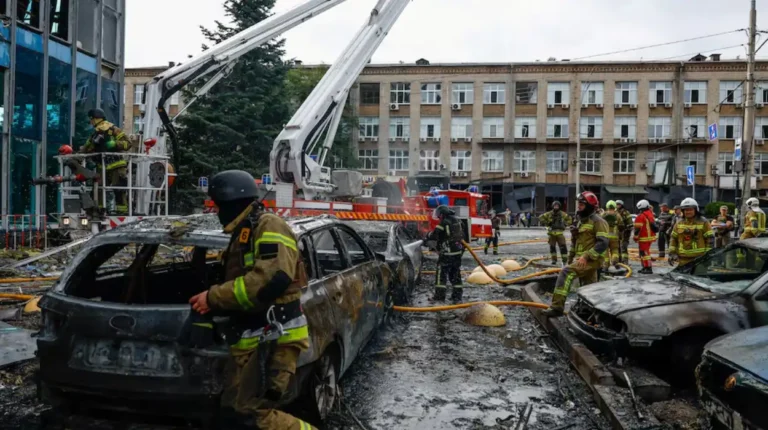
The timing of Zelensky’s statement amplified its urgency. Overnight into April 26, 2026, Russia unleashed over 100 drones across Ukraine, a salvo that claimed at least five lives in multiple regions. These near-nightly assaults, persisting since the invasion’s outset, have become a grim hallmark of the conflict, blending precision strikes with indiscriminate terror.
Zelensky spotlighted a pivotal incident from February 14, 2025, when a Russian drone, armed with a high-explosive warhead, slammed into the NSC arch during a broader attack involving 133 Shahed drones of which Ukrainian defenses downed 73. Radiation levels remained stable post-strike, averting immediate catastrophe, but the International Atomic Energy Agency (IAEA) warned of dire repair challenges amid hostilities.
From a counter-terrorism perspective, these drone operations evoke the asymmetric warfare playbook long associated with groups like ISIS or Hezbollah: low-cost, high-impact munitions that terrorize populations while probing defenses. Russia’s deployment of Iranian-designed Shaheds near Chernobyl, however, injects a nuclear dimension, transforming tactical strikes into potential escalatory threats. Zelensky’s rhetoric positions this as “nuclear terrorism”, a term that invokes deliberate endangerment of critical infrastructure to coerce compliance.
IAEA Director General Rafael Grossi emphasized the peril, noting repairs to the NSC could span years under wartime conditions, heightening leak risks from the entombed reactor.
“Urgent repairs are needed but complicated by the war,”
Grossi conveyed, as relayed in reports following the incident. This vulnerability underscores a counter-terrorism dilemma: how to deter state actors from actions that mimic terrorist impunity without provoking nuclear brinkmanship.
Russia’s Rebuttals: Denial, Deflection, and Counter-Accusations
Moscow’s response to Zelensky’s charges has been characteristically dismissive, rejecting the 2025 Chernobyl strike outright as Ukrainian propaganda aimed at sabotaging peace negotiations. Russian state media and officials portray Kyiv as the aggressor, accusing Ukraine of shelling the Zaporizhzhia Nuclear Power Plant seized by Russia in early 2022 and other Russian facilities. Rosatom, Russia’s atomic energy corporation, champions its Chernobyl “lessons learned” to avert repeats, yet faces Western calls for sanctions over Zaporizhzhia mismanagement. A Kremlin aide, commenting on analogous claims, labeled them “silly”, insisting Russia safeguards occupied sites meticulously.
This tit-for-tat narrative exemplifies hybrid warfare’s counter-terrorism challenge, where both sides weaponize nuclear fears. Russia’s control of Zaporizhzhia, Europe’s largest nuclear plant, has drawn repeated IAEA rebukes for safety lapses, including staff detentions and mining around the perimeter. By denying Chernobyl strikes while amplifying Ukrainian “provocations,” Moscow deflects scrutiny, recasting itself as victim in a bid to erode Western resolve. In terrorism analysis, this mirrors disinformation tactics employed by state sponsors like Iran or North Korea sowing doubt to legitimize aggression.
Zelensky’s appeal for global intervention dovetails with broader counter-terrorism imperatives.
“The world must respond to this nuclear terrorism,”
he urged, echoing calls from outlets like WION and Euronews. Yet enforcement remains elusive; sanctions on Rosatom have stalled amid energy security concerns, highlighting the asymmetry between countering non-state terrorists and peer adversaries.
Counter-Terrorism Implications: State Actors and Nuclear Thresholds
Zelensky’s accusation reframes Russia’s Ukraine campaign through a terrorism prism, challenging post-9/11 doctrines predicated on non-state threats. Traditional counter-terrorism SWAT raids, financial chokepoints, no-fly lists falters against a UN Security Council permanent member wielding 5,580 nuclear warheads. The Chernobyl episode exposes gaps in the nuclear non-proliferation regime, where IAEA monitoring yields admonitions but no enforcement teeth. Ukraine’s plight illustrates “nuclear terrorism” by proxy: not suitcase bombs, but state-orchestrated risks to civilian infrastructure, amplifying dread exponentially.
Historically, state-linked nuclear terror evokes Cold War saber-rattling, yet today’s drones democratize the threat, blurring lines between conventional and terrorist warfare. Zelensky’s stance aligns with Ukraine’s “victory plan,” demanding NATO guarantees and sanctions to deter Moscow.
“Russia’s reckless attacks must end,”
he reiterated, positioning counter-terrorism as collective defense. Think tanks like this one advocate expanding definitions under UN Resolution 1373 to encompass state nuclear endangerment, potentially unlocking Terrorism Exclusion List designations for enablers like Iran’s drone suppliers.
Western hesitancy persists, tempered by escalation fears. U.S. and EU statements post-April 26 condemned the drone wave but stopped short of endorsing “nuclear terrorism,” prioritizing de-escalation. This reticence risks normalizing hybrid threats, eroding deterrence as Russia tests nuclear redlines from Chernobyl overflights to Zaporizhzhia occupation.
Global Ripples and Pathways Forward
The Chernobyl anniversary collision of memory and missile underscores terrorism’s evolution. Russia’s actions, if deemed nuclear terror, demand recalibrated responses: fortified IAEA mandates, drone-export bans, and hybrid warfare coalitions akin to the Global Coalition to Defeat ISIS. Zelensky’s bold framing galvanizes support, yet requires substantiation beyond rhetoric independent forensics on the 2025 strike could bolster cases at the International Criminal Court.
In counter-terrorism’s grand strategy, this episode warns of nuclear facilities as soft targets in great-power contests. Ukraine’s resilience downing 73 of 133 drones exemplifies adaptive defenses, but sustained vigilance is paramount. As Grossi warns, protracted conflict invites accident, echoing Chernobyl’s lesson: hubris begets apocalypse. The international community must heed Zelensky’s call, forging counter-terrorism tools resilient to state adversaries, lest history’s scars reopen in radioactive fury.