European Commission President Ursula von der Leyen captured the sense of major transformation among European leaders at this weekend’s Munich Security Conference when she said that certain boundaries had been crossed and could not be reversed.
Transatlantic relations have already been under strain over the past year following Donald Trump’s return to the White House. However, Trump’s effort to annex Greenland significantly intensified European concerns about Washington’s willingness to continue protecting the continent through NATO.
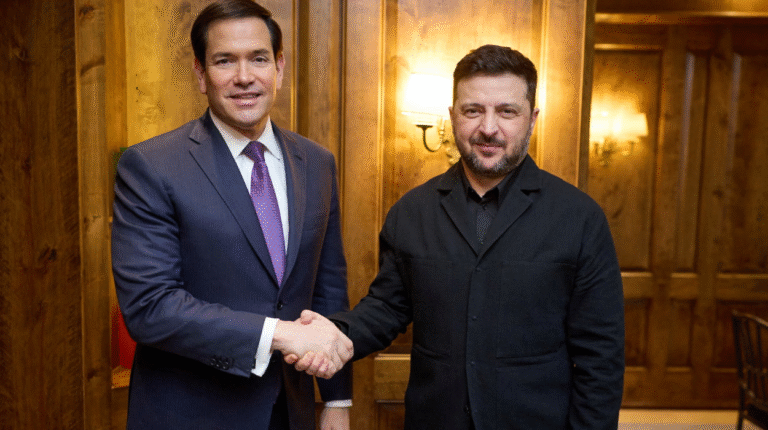
US Secretary of State Marco Rubio offered only limited reassurance in his conference address. While he adopted a friendlier tone than Vice President JD Vance had the previous year and said the United States wanted to cooperate with Europe, he also criticized Europe’s recent political trajectory. Rubio avoided mentioning NATO, Russia, or Moscow’s war in Ukraine—topics where a widening divide has emerged between the US and its NATO partners.
As the war approaches its fifth year and Russia is increasingly viewed as a threat by neighbouring European states, leaders across the continent said they would speed up efforts to strengthen their own defence capabilities and reduce their reliance on the United States.
In principle, this aligns with Trump’s position. His administration has stated that Europe should take primary responsibility for its conventional defence in the coming years, while Washington would maintain its nuclear umbrella and uphold NATO’s collective defence commitments.
What Is the “European Pillar” Within NATO?
German Chancellor Friedrich Merz, French President Emmanuel Macron, and British Prime Minister Keir Starmer reiterated in Munich their commitment to building a stronger “European pillar” inside NATO. At the same time, strengthening Europe’s own defence capabilities is seen as insurance in case Trump—or a future US leader—chooses not to defend Europe.
Merz told the conference that this new beginning was necessary under all circumstances, whether the United States continued to distance itself or whether Europe remained unable to guarantee its own security independently.
In another indication of unease over US security guarantees, Merz revealed that he had begun discussions with Macron on establishing a European nuclear deterrent.
France currently possesses the only truly independent nuclear deterrent in Europe, as Britain’s Trident nuclear system is produced and maintained by the United States.
Will Europe’s Actions Match Its Rhetoric?
The central question for European leaders is whether they can translate their commitments into concrete action, including purchasing and developing new weapons systems, addressing gaps in military capabilities such as long-range missiles, and coordinating defence efforts across the continent.
So far, the signals have been mixed.
Motivated by concerns about Russia and pressure from Trump, European countries have increased defence spending. NATO members agreed last year to raise core defence expenditure from 2% of GDP to 3.5%, with an additional 1.5% allocated to other security-related investments.
Von der Leyen told the Munich conference that European defence spending has increased by nearly 80% since before Russia’s invasion of Ukraine.
European states are also forming partnerships to develop sophisticated weapons platforms. Defence ministers from France, Germany, Italy, Poland, and Sweden signed a letter of intent to advance the European Long-range Strike Approach (ELSA), aimed at developing deep-strike missile capabilities.
On the sidelines of a NATO defence ministers’ meeting, European coalitions agreed to collaborate on four initiatives, including ballistic missile defence and air-launched munitions.
Why Are European Defence Projects Struggling With Internal Disputes?
Despite these efforts, several major pan-European defence projects have faced significant delays. The future of the French-German-Spanish Future Combat Air System (FCAS) fighter jet programme has remained uncertain for months due to disagreements over how industrial work should be distributed among participating companies.
Discussions over European Union defence initiatives have also been complicated by disputes over whether projects should be restricted to EU firms or opened to international partners.
France has been the strongest supporter of “buy European” rules, while countries such as Germany and the Netherlands have argued for a more open procurement approach.
As policymakers debated inside the luxury Bayerischer Hof hotel, Ukrainian President Volodymyr Zelenskiy underscored the realities of modern warfare, standing before large screens displaying data and imagery of Russian strikes. Ukraine alone was hit by more than 6,000 drones and 150 missiles in the previous month.
Zelenskiy told delegates that during the war, weapons technology has evolved faster than the political decisions designed to counter them.