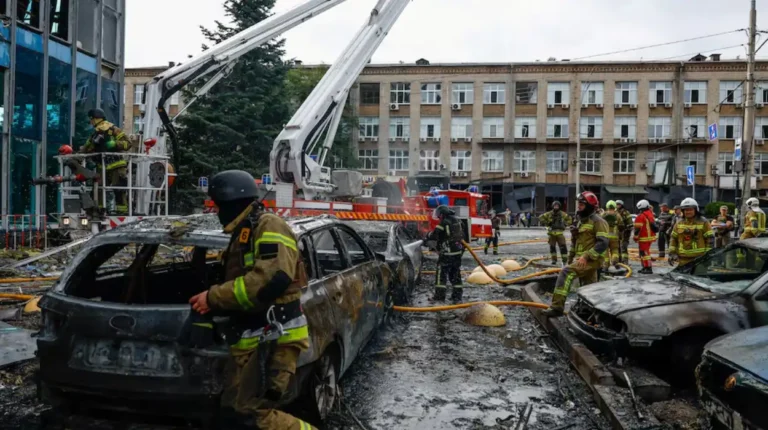
One of the most destructive air raids that has been seen in months hit the important Ukrainian cities on Tuesday, June 2, 2026, with at least 18 civilians killed and many others being injured. These air strikes have taken place in Kyiv, Dnipro, as well as the other cities of Kharkiv, Zaporizhzhia, and Odesa as part of an intense effort from Russian forces to target important Ukrainian cities.
The raid took more than 12 hours of continuous air strikes with over 600 drones along with some missiles and even hypersonic missiles used. This air strike is considered among the biggest attacks that Russia has mounted against Ukraine within the year with the main damage being done to civilian residential areas.
Scenes from Russia's overnight $330,000,000 missile and drone attack on Ukraine’s civilian population. pic.twitter.com/9jYBDhDuRy
— Jay in Kyiv (@JayinKyiv) June 2, 2026
Devastating Human Toll Across Multiple Cities
The toll on human life from Tuesday’s strikes was massive. Six people died in Kyiv with another 64 injured, making this one of the deadliest attacks the Ukrainian capital has witnessed recently. The strikes targeting residential zones led to the displacement of citizens and panic as they sought refuge in shelters after hearing air-raid alarms ring across the city.
In the Ukrainian city of Dnipro, which is situated in the center of Ukraine, the death toll reached 12, including two children. The seriousness of the strikes became apparent as the region’s infrastructure collapsed. In addition, the number of casualties in Ukraine’s second largest city Kharkiv was 14, including one child. The other two cities affected by the strikes are Zaporizhzhia and Odesa.
The casualty figures continue to rise as emergency responders search through rubble in affected neighborhoods. Ukrainian authorities emphasized that the true death toll may be higher as rescue operations continue in areas where access remains difficult due to ongoing danger and structural instability.
Unprecedented Scale of Russian Aerial Assault
It is the sheer magnitude of the attack mounted on Tuesday that sets it apart from previous strikes against Ukraine from Russia. Russian troops have reportedly employed over 600 attack drones for the first time along with an armada of missiles, including hypersonic missiles that cannot be detected and intercepted by air defense systems.
According to sources, almost 500 drones and over 40 missiles hit Ukrainian soil during one such attack which lasted well beyond 12 continuous hours. Such a prolonged attack drained air defenses of their ammunition in several places and also made it possible for the Russian side to target several objectives at once.
The inclusion of hypersonic missiles in this attack represents a technological escalation. These weapons travel at speeds exceeding Mach 5, making them extremely difficult to intercept with conventional air defense systems. Their deployment signals Russia’s willingness to employ its most advanced weaponry against civilian targets.
Ukrainian Officials Condemn Civilian Targeting
Ukrainian officials responded swiftly to the attack with strong condemnation of Russia’s targeting of civilian infrastructure.
“This was one of the most lethal attacks seen in months, striking vital civilian infrastructure and residential areas,”
Ukrainian authorities stated, emphasizing the deliberate nature of the assault on non-military targets.
The coordinated nature of the strikes across multiple cities suggested careful planning and strategic intent to maximize civilian casualties and infrastructure damage.
“Russian forces struck vital civilian infrastructure across Kyiv, Dnipro, Kharkiv, and other cities, causing widespread power outages and forcing residents into shelters,”
officials reported as air raid sirens blared throughout the night.
Dnipro regional leader Oleksandr Ganzha provided specific details about the devastation in his region, reporting “dozens injured alongside the fatalities” as rescue teams worked through the night to reach survivors trapped under collapsed buildings. The regional leader’s statement underscored the localized impact of the broader offensive
Widespread Infrastructure Damage and Power Outages
There was massive destruction caused to civilian facilities in different cities within Ukraine. The residential houses were destroyed, and people had nowhere to go during the freezing weather conditions. There was massive destruction caused to the power grid system, hence causing massive power blackouts in the affected areas.
All these utilities became victims of these strikes. The disruption in these facilities had resulted in the emergence of secondary crises among the civilians since people would no longer be able to have access to drinking water, proper heating, and any means of communication with their loved ones and emergency authorities. There were sirens announcing air raids continuously for many hours as civilians fled to shelters underground or basements. The prolonged attacks made sure that civilians could not come out from their shelters despite the end of the strike.
Russia Reports Minimal Casualties from Ukrainian Counter-Strike
Although the offensive by Russia led to many fatalities for Ukraine, the Russian government stated that its casualties from the Ukrainian drone attack were minimal. Russia lost 2 individuals including one child to the Ukrainian drone attack in the Krasnodar region of Russia (Tuapse city), where there was also an injury to five people during the counter-offensive.
This is a clear indicator of the disparity between the two nations as Russia was able to attack Ukraine deep into its territory while maintaining its border safe from any attacks from Ukraine. The attack on Russia by the Ukrainian drone was viewed as minor when compared to the offensive on Ukraine.
International Concerns Over Civilian Safety Escalate
The unprecedented scale of Tuesday’s attack has reignited international concerns about civilian safety in the ongoing war. Human rights organizations and foreign governments expressed alarm over the deliberate targeting of residential areas and civilian infrastructure, which may constitute violations of international humanitarian law.
The destruction of homes and critical infrastructure has created a worsening humanitarian situation for Ukrainian civilians already struggling with the effects of years of war. Displaced families face uncertain futures as their neighborhoods lie in ruins and essential services remain non-functional.
Context of Russia’s Escalating Air Campaign
This bombing marks one of the biggest aerial attacks conducted by Russia against Ukraine this year, and the increasing trend shows how intense this type of warfare is becoming against civilian targets. The use of over 600 drones and missiles indicates that Russia has developed the ability to conduct sustained air attacks against its opponents. This comes at a time when Russia is preparing itself for a likely ground war this spring.
Ukraine has been focusing on disrupting Russian supply and logistics networks using advanced drone operations, while Russia has simultaneously increased its aerial attacks on Ukrainian territory. This tit-for-tat escalation has intensified the humanitarian cost of the conflict for civilians on both sides, though the scale of destruction remains heavily weighted toward Ukraine.
Emergency Response and Rescue Operations Underway
Massive rescue operations have been put in place by emergency response teams in all cities that were affected by the bombings as they work through hazardous conditions to save lives of people trapped underneath the rubble.
Hospitals in Kyiv, Dnipro, and Kharkiv have implemented plans for dealing with large numbers of casualties; many victims, even children, have been treated for injuries sustained during the bombings. Supplies at hospitals were reportedly running out because of the sudden influx of patients.
Long-Term Implications for Civilian Population
The Tuesday offensive has long-term implications for Ukraine’s civilian population beyond immediate casualties. The destruction of residential infrastructure means thousands face displacement and housing insecurity. The damage to power grids and water systems will require months of repair work, leaving residents without essential services during critical periods.
Rebuilding efforts will require substantial international assistance and funding, adding to the already massive economic cost of the war. The psychological trauma experienced by survivors, particularly children among the victims, will have lasting effects on communities for generations.
As Ukraine mourns the victims of this deadliest offensive in months, the international community faces renewed pressure to address the humanitarian crisis and strengthen protections for civilian populations caught in the crossfire of this devastating conflict.