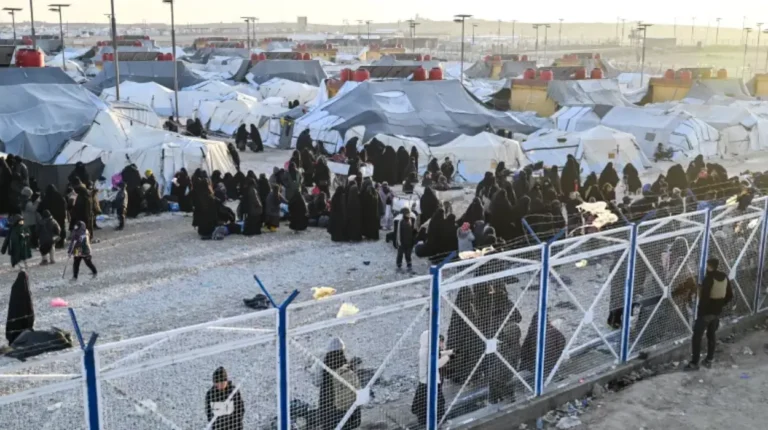
Amid the violence and chaos of Sudan’s civil war, 13-year-old Hadeer, her mother and three younger siblings fled their home in Omdurman to a displacement camp in Atbara, about 320 kilometres to the northeast. Hadeer’s aunt and uncle were extinguished, her cousins escaped the country, and her family lost touch with her father.
With the war ranting, education had become an alien relation. Hadeer never thought she would be capable of learning again. Using an alias for her safety, Hadeer told Save the Children, an international charity that constructed a school in her camp, how she desired to be an architect when she grew up.
“At home, we had skills and electricity, and I could walk [to school] and study safely,” she stated. “But here I feel nervous when I walk in the streets, not like there [home].” After more than a year of fighting between the paramilitary Rapid Support Forces militia and the Sudanese Armed Forces, about 25 million people, or half of the country’s population, need humanitarian aid, according to the United Nations.
In April 2024, the U.N. calculated that 4 million children had been moved from their homes since fighting began in April 2023, including nearly 1 million children travelling into neighbouring Chad, Egypt and South Sudan, among others. Sudan has among the most destructive education crises in the world, as the prevalence of schools is closed and more than 90% of its 19 million school-age children have had no access to legal education for more than a year.
UNICEF Deputy Executive Director Ted Chaiban named it a “generational catastrophe.” “The scale of conditions is so staggering that it’s hard to put into view,” he said in an April 14 statement. “These numbers designate millions of children with names, stories, wishes and dreams. “Yet without a substantial scale-up of critical life-saving services, a reopening of schools, and most fundamentally an end to the war, these longings and dreams will be lost for a generation and the future of Sudan.”
Violent raids on schools in Sudan have grown fourfold since the conflict started, as Save the Children reported 88 damaging incidents in an analysis published on May 28. Among them were airstrikes on schools that resulted in casualties and injuries to students and teachers, torturing of instructors, killing and abduction of teachers, and sexual brutality against students inside education facilities.
Other reported happenings included the occupation of schools by armed groups, the usefulness of schools as weapons storage buildings, and battles fought on school lands. “It’s not just children’s lives that are on the line, but also their futures,” Save the Children Sudan Director Dr. Arif Noor stated in a statement. “Millions of children persist to face disruptions to their education with their schools killed by bombs, taken over as shelters for expelled families, or learning stopped as children flee.”
Sudanese refugee Fatima Abdallah Abusikin Idriss, 19, looked at the International University of Africain Khartoum in the faculty of languages and Islamic studies, Arabic department, before retiring to a transit centre for refugees in Renk, South Sudan. In a May 21 video consultation with the U.N. High Commissioner for Refugees, she requested to deliver a message to the warring parties. “Stop the fight as soon as possible, because lives are being destroyed,” she said. “People are not going to school, some have perished and others have been displaced. Families have been torn apart.”