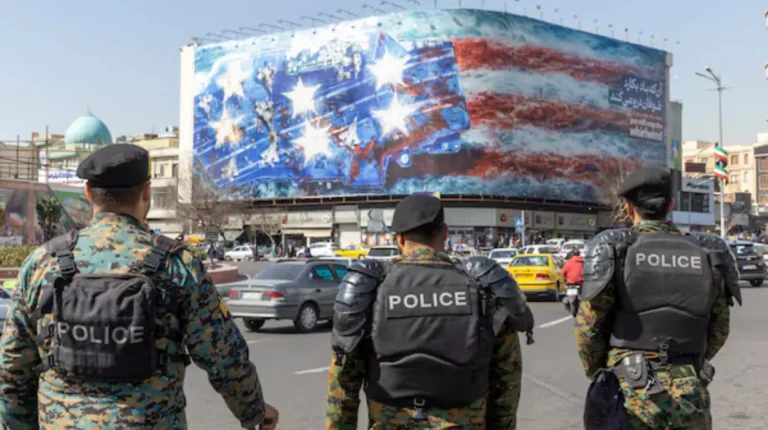
Only hours after the United States made the announcement of the kidnapping of the Venezuelan President, Nicolas Maduro, Israeli opposition leader Yair Lapid had a warning for the Iranian government.
“The Iranian government ought to take a very close look at the situation in Venezuela,”
Lapid stated, indicating that Iran might also feel the effects of the United States’ bold action in Venezuela.
The removal of the Maduro regime occurred just days after US President Donald Trump held talks with Israeli Prime Minister Benjamin Netanyahu, threatening Iran again with military strikes, leading to fears that these separate events could become inextricably linked.
Does Maduro’s abduction raise the risk of war with Iran?
Although Washington’s confrontations with Caracas and Tehran stem from different political and strategic contexts, analysts warn that Trump’s decision to target Maduro could accelerate the path toward conflict with Iran.
“A new lawlessness makes everything less stable and war more likely,” said Jamal Abdi, president of the National Iranian American Council (NIAC). Abdi argued that whether Trump becomes enamoured with what he described as “surgical” regime change, or grants Israel a US green light for similar operations, the momentum is clearly shifting toward confrontation.
He warned that the abduction of Maduro could push Iran to take actions that trigger military escalation, including accelerating its military deterrence or launching preemptive measures against US or Israeli strikes.
Is diplomacy with Tehran becoming increasingly unlikely?
Negar Mortazavi, a senior fellow at the Center for International Policy, said the US operation in Venezuela underscored Trump’s maximalist approach to foreign policy, further diminishing prospects for diplomacy with Iran.
“What I see and hear from Tehran is that they are not interested in negotiating with the Trump administration the way this administration signals that they want total surrender,” Mortazavi told Al Jazeera.
She added that the absence of diplomatic pathways leaves only the alternative of confrontation. “Right now, Israel, Iran and the US are on a path to potential conflict,” she said. Abdi echoed that assessment, saying the Maduro operation reinforced deep scepticism within Iran about US intentions and strengthened arguments in Tehran favouring the development of a nuclear deterrent.
Why does the Iran–Venezuela alliance matter to Washington?
The US raid that led to Maduro’s abduction followed months of escalating rhetoric from Trump and senior US officials against Venezuela’s government. Washington has accused Maduro of leading a drug trafficking organisation, while Trump and his advisers have increasingly asserted that the United States is entitled to Venezuela’s vast oil reserves.
Secretary of State Marco Rubio has repeatedly highlighted Caracas’s ties to Tehran, accusing Venezuela—without providing evidence—of allowing Hezbollah to establish a foothold in the Western Hemisphere.
Maduro has long been Iran’s close ally, as both sanction-loaded countries have been developing their level of bilateral trade relations estimated to reach billions of dollars. With the removal of Maduro, Iran’s already weak list of allies might lose more strength after the downfall of Syrian President Bashar al-Assad and the weakening position of Hezbollah in Lebanon.
How did Iran respond to the US action in Venezuela?
Tehran swiftly condemned the US operation, urging the United Nations to intervene and halt what it described as “unlawful aggression”. “The US military aggression against an independent state that is a member of the UN represents a grave breach of regional and international peace and security,” Iran’s foreign ministry said.
The ministry warned that the consequences would reverberate across the international system and further erode the UN Charter-based global order.
Meanwhile, Rubio framed Maduro’s abduction as a broader warning to Washington’s rivals. “When he tells you that he’s going to do something, when he tells you he’s going to address a problem, he means it,” he told reporters. Iran’s Supreme Leader Ali Khamenei responded defiantly, writing on social media: “We will not give in to the enemy. We will bring the enemy to its knees.”
Are Trump’s threats against Iran escalating?
Last week, Trump hosted Netanyahu in Florida and threatened to bomb Iran again if it attempts to rebuild its missile or nuclear programmes. “Now I hear that Iran is trying to build up again, and if they are, we’re going to have to knock them down,” Trump said. “We’ll knock them down. We’ll knock the hell out of them.”
Israel launched a war against Iran in June, killing senior military commanders, nuclear scientists, and hundreds of civilians. The US joined the assault by bombing Iran’s three main nuclear facilities.
While Trump has repeatedly claimed the strikes “obliterated” Iran’s nuclear programme, Iran’s governing system survived. Tehran retaliated with hundreds of rockets against Israel, many of which penetrated its air defences, and Iranian forces continued firing until the ceasefire took effect.
Critics argue that regime change has long been Israel’s objective in Iran, an aim Trump appears increasingly willing to embrace.
Could Iran face a Venezuela-style leadership operation?
Trump has repeatedly warned Iran that the US is “locked and loaded” if the government suppresses protesters amid ongoing demonstrations. He renewed those threats on Sunday, warning that Iran would be hit “very hard” if it resumed lethal crackdowns.
Abdi noted that Israel has already attempted to assassinate senior Iranian leaders, including President Masoud Pezeshkian, during the June conflict. Trump himself repeatedly threatened Khamenei, and Israeli officials confirmed they sought to eliminate the supreme leader.
“Iranian officials have said they accordingly have plans in place so that killing or removing senior leaders does not paralyse or topple the regime,” Abdi said. He added that carrying out a Venezuela-style “snatch and grab” in Iran would be far more complex due to Tehran’s capacity to retaliate against US interests and personnel across the region.
Has removing Maduro destabilised Venezuela?
Despite Maduro’s abduction, Venezuela has not experienced immediate regime collapse.
On Sunday, Vice President Delcy Rodríguez, now acting president, insisted Maduro remains Venezuela’s legitimate leader and condemned the US operation. She suggested Israel played a role in the abduction and accused Washington of acting with “Zionist undertones”.
Trump responded by threatening Rodríguez, telling The Atlantic that she would pay a “very big price, probably bigger than Maduro” if she failed to comply with US demands. Analysts say Trump’s ambitions for “running” Venezuela and controlling its oil remain unfinished and may require further military involvement.
Could Venezuela become a prolonged US military engagement?
Mortazavi questioned whether Venezuela could be a quick operation. “I doubt Venezuela can be a ‘one and done’ or a quick ‘in and out’ situation,” she said, noting Trump’s preference for swift shows of force rather than prolonged wars.
She cited previous rapid operations ordered by Trump, including the killing of ISIL leader Abu Bakr al-Baghdadi, the assassination of Iranian General Qassem Soleimani, and the June strikes on Iran’s nuclear sites.
However, Trump has openly floated the idea of a ground invasion. “We’re not afraid of boots on the ground,” he said.
“We’re going to make sure that that country is run properly.”
Abdi suggested that a prolonged US engagement in Venezuela could paradoxically delay a new war with Iran by stretching Washington’s military focus.
Is oil the strategic link between Venezuela and Iran?
Some critics, including Republican Congresswoman Marjorie Taylor Greene, argue that controlling Venezuela’s oil could cushion global energy markets in the event of war with Iran.
“By removing Maduro, this is a clear move for control over Venezuelan oil supplies that will ensure stability for the next obvious regime change war in Iran,”
Greene wrote on X.
Around 20 percent of the world’s oil passes through the Strait of Hormuz, which Iran could attempt to close during a major conflict.
Abdi acknowledged that Venezuelan oil could theoretically offset disruptions but cautioned
against premature conclusions. “This would mean a lot of things going right for the US in Venezuela,” he said.
“And it is probably far too soon to make that judgement.”