Saudi Arabia has called on the factions in Yemen’s south to come to an emergency “dialogue” in Riyadh after the escalation of violence has revealed the deepest split yet between Riyadh and Abu Dhabi. This has come at the time when the conflict between the government-led forces backed by the Saudis and the separatist forces backed by the UAE is on the verge of derailing the long-standing Gulf coalition.
Saudi Arabia stated this in a statement released by its foreign ministry, describing the internationally-recognised government in Yemen as having called on “all southern factions to join the comprehensive conference in order to address the ‘southern cause’ through just solutions.”
#Statement | In response to the request of H.E. Dr. Rashad Al-Alimi, President of the Yemeni Presidential Leadership Council, to convene a comprehensive conference in Riyadh to bring together all southern factions to discuss just solutions to the southern cause. pic.twitter.com/uWfJWeth13
— Foreign Ministry 🇸🇦 (@KSAmofaEN) January 3, 2026
How did Saudi Arabia and the UAE end up backing rival forces?
As part of a coalition aimed at regaining the control of the internationally recognised government due to the takeover of a large part of northern Yemen, including the capital city Sanaa, by Houthi forces supported by Iran, Saudi Arabia and the UAE were amongst the countries participating in the civil war in Yemen since 2015.
However, it gradually collapsed over time. This is because, while Saudi Arabia continued its support for the central government, Abu Dhabi started supporting southern groups, especially the Southern Transitional Council, whose vision it is to see an independent state in southern Yemen after the fall of al-Houthi.
How did Saudi air strikes intensify the confrontation?
Saudi-led coalition aerial bombings greatly escalated the conflict in a Saudi-UAE-backed Southern Transitional Council (STC) force standoff in Yemen when it comes to a UAE withdrawal from terrorism.
The situation took a drastic turn in late December 2025 with Saudi forces deferring accusations against the UAE for allowing STC separatists to be armed and directly forcing a military attack with unclear definitions within coalition forces. The attacks were on UAE-related assets, accelerating their withdrawal from Yemen altogether.
On 26 December 2025, Saudi Arabian-led coalition warplanes struck an STC military camp in Hadramawt Province, killing at least seven STC fighters and injuring some others, according to an STC spokesperson, Aydarus al-Nubi. The STC described the attack as a “heinous act of betrayal,” asserting that it has sabotaged the “joint fight against the Houthis and AQAP in the rich oil provinces.”
#Statement | Pursuant to the statement issued by the Ministry of Foreign Affairs on 25/12/2025 corresponding to 5/7/1447 regarding the Kingdom’s concerted efforts, working with the brotherly United Arab Emirates, to end and contain the escalatory steps taken by the Southern… pic.twitter.com/lTyU0gLgpf
— Foreign Ministry 🇸🇦 (@KSAmofaEN) December 30, 2025
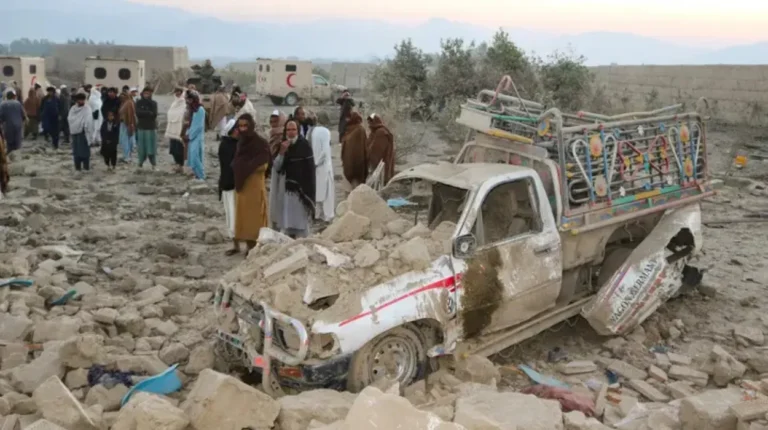
This was preceded by sectarian violence on December 23 in strikes at Mukalla, Yemen’s southern port city, when Saudi allegations of UAE arms supplies surfaced. The destruction of UAE-registered military vehicles, suspected to be technicals and logistical trucks, at a checkpoint in footage on social media showed precision-guided missiles with neither Emirati casualties confirmed, as illustrated below.
The crisis further heightened on 2 December, as the UAE-backed STC began a massive military offensive in eastern Yemen, quickly overrunning territory held by the country’s government. The offensive had the goal of encompassing the province of Hadramawt, which borders Saudi Arabia and contains the country’s oil reserves.
#Statement | The Kingdom of Saudi Arabia points out that the military movements in the governorates of (Hadramout and Al-Mahra), recently conducted by the Southern Transitional Council, were carried out unilaterally, and without the approval of the Presidential Leadership Council… pic.twitter.com/6JPJIMIJ1v
— Foreign Ministry 🇸🇦 (@KSAmofaEN) December 25, 2025
The reasons given by the STC for the action were the need to “restore stability” within southern Yemen. However, the country’s Presidential Leadership Council rejected the action as an attempt at rebellion that could end up breaking the country into pieces.
How has the UAE responded to Saudi accusations?
The UAE has strongly rejected the Saudi claim that they provided weapons to the STC, while asserting that the shipment was not armed in any way and the vehicles were meant for the UAE forces in Yemen.
UAE Statement on Ongoing Developments in Yemenhttps://t.co/UVDyX2yKDk pic.twitter.com/mXYfDP9Y9W
— MoFA وزارة الخارجية (@mofauae) December 30, 2025
Yet, even as it denied charges of launching the STC offensive, a surprising action was taken by Abu Dhabi with regard to its forces in Yemen when it agreed to pull them out. This latest move indicates a drastic change in its policy and strategy. However, it is a far cry from a retreat.
Does the UAE’s withdrawal really change the balance on the ground?
The UAE’s physical withdrawal will not affect realities in southern Yemen, according to experts. The UAE does not have many troops on the ground since 2019 and focuses on its special forces and local proxies on the ground.
“The UAE does not have a strong military presence in Yemen. It’s been years,” said Farea al-Muslimi of Chatham House. “Its power is through its local partners, not the ground troops it has in the country.”
What does the STC ultimately want?
There are no secrets about the ambitions of the Southern Transitional Council. The head of the Southern Transitional Council, Aidarous al-Zubaidi, has been urging the revival of the independent state of southern Yemen. This has been long before the current escalation.
“Our agenda has always been evident,” said STC spokesperson Anwar al-Tamimi in an interview with the BBC. “It is the right of the people in the south to determine their future.” He dismissed Saudi Arabia’s fears when asked whether an independent southern Yemen might find itself at the center of either security concerns or radicalization.
How are civilians reacting to the growing instability?
For the residents who now live within the contesting regions like Mukalla, the idea of more battles only brings consternation. “People are considering going to the countryside or staying with relatives if the situation worsens,” said Mohamed, who is a resident of Mukalla. “Most people, however, do not really have the choice to leave,” he explained.
What is the humanitarian toll as Yemen’s conflict deepens?
Years of war have caused sufficient damage to Yemen’s economy and social structure. The population of Yemen is around 40 million people and is experiencing what is classified as the third-worst hunger situation in the world by humanitarian organizations.
The UN estimates that as of 2021, 377,000 people had lost their lives due to the conflict as well as its ripple effects, such as starvation and the breakdown of healthcare systems. Of this total, 259,000 were children under the age of five years.
Is this becoming a proxy war between Gulf powers?
Although the current conflict is viewed as a nascent proxy war between Saudi Arabia and the United Arab Emirates, Yemen analysts point out that the underlying factors extend further. The strengthening grip exercised by the STC over southern Yemen has encouraged its leadership enough to make a confrontation unavoidable.
“The UAE and Saudi Arabia cannot see eye to eye in Yemen becausetheir priorities differ fundamentally,” al-Muslimi added. “Saudi Arabia has a 1,500km long common border with Yemen. The UAE has no common border whatsoever”with Yemen. Any direct confrontation between Saudi Arabia and the UAE “would be a catastrophe in the whole Gulf, like France and the UK fighting each other.”