An American United States Army AH-64 Apache helicopter crashed near the vital Strait of Hormuz on Monday, June 8, 2026, during its patrol around the waters near the Omani coastline, representing the first loss of an Apache helicopter in the prolonged conflict of 101 days involving the war among Iran, Israel, and America. Both the pilot and co-pilot/gunner from the US Army Apache gunship were saved after approximately two hours from the crash and put in good shape, reported by US Central Command. It is estimated that the value of the airframe alone costs about $35 million to $40 million, while the complete unit is worth $52 million to $100 million. The helicopter was utilized to enforce a blockade imposed against the ports of Iran located near the vital strait still controlled by Iran.
This incident took place at a time of high tension between Iran and the US government, following the outbreak of hostilities in the area, whereby Iran and Israel exchanged their first strikes in two months. It is a heavy blow to the US armed forces because the US has lost more than 42 aircraft from accidents such as friendly fire and combats in which the aircraft destroyed included the F-15 fighter jets, F-35 Lightning II aircraft, drones, and HH-60W Jolly Green II combat search and rescue helicopters. According to the President,
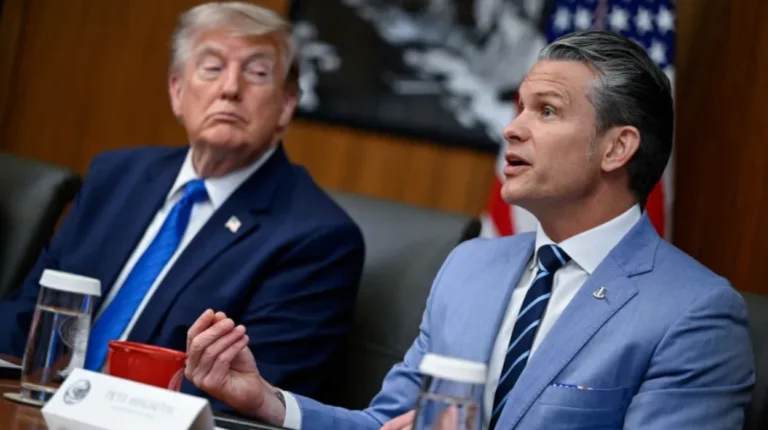
“The pilots are fine, nobody injured,”
and he added that a full report will be issued tomorrow.
Trump’s Official Statement: Pilots Safe After Unprecedented At-Sea Drone Rescue
Speaking on the runway at John F. Kennedy International Airport before returning to Washington, D.C., after attending the NBA Finals game on Monday night, Trump told journalists in New York that
“the pilots are fine, nobody injured. We are going to issue a report tomorrow. But the pilots are fine.”.
The president’s statement came as US authorities confirmed the successful rescue operation that marked unprecedented use of unmanned surface vessels for combat search-and-rescue missions in active conflict zones.
According to the US Central Command, the soldiers have been rescued safely in about two hours and are currently in good health, and the process of rescuing was headed by U.S. Naval Forces Central Command and the 82nd Airborne Division, among others, with the help of units from the U.S. Air Force and Navy, such as Task Force 59 from the United States Fifth Fleet. The entire process of rescue is unique due to its at-sea nature whereby an unmanned ship operating through the use of drones found the team of the US Apache helicopter that was crashed near the Strait of Hormuz.
This was made possible by the unmanned surface vehicle, which not only detected the crew in the waters near Oman but also successfully transported them to land. According to the military, the unmanned surface vessel in question rescued a crew whose helicopter crashed in the nearby strait of Hormuz on Monday evening. The rescue mission, conducted by the U.S. Navy using an unmanned surface vehicle, marks a first of its kind in marine warfare operations, and it clearly showcases how technology has advanced military warfare operations in recent times.
Investigation Underway: Cause Remains Uncertain Between Iranian Fire, Mechanical Failure, or Other Problems
The US government has made known the fact that there is now an investigation under way in order to see if the Iranians were behind the shooting down of the Apache helicopter, but it is yet not certain what the reason behind the event is as investigators explore different possibilities as to why this might have happened. It is not known whether the Apache was shot down by the Iranians or had a malfunction or for any other reason.
The three main hypotheses which are going to be examined involve the possibilities of Iranian gunfire, a mechanical problem, or any other problem which may have been responsible for the crash. The reasons behind the occurrence of the event are still under examination and the US Central Command and the military force are examining the situation. An investigation involving the analysis of data from various sources will be carried out to find out the exact reason for the crashing of the aircraft, whether it was due to Iranian attacks or any other reason.
The implication that Iran was behind the crash would put into question any potential peace agreement that could have been struck between the United States and Iran, but at present, there is no indication by either party that this might be the case. State-run media in Iran mentioned the incident, although it cited foreign sources. However, it did not provide any additional information, suggesting that the incident has not been claimed by Iran. According to The Jerusalem Post report, it is not yet known if the Apache helicopter was shot down by Iranian forces, if it failed mechanically, or if it went down for some other reason.
Strategic Context: Apache Helicopters Policing Iranian Ports Near Iran-Controlled Waterway
The Apache helicopter was undertaking patrol missions in the strategically important Strait of Hormuz, which is one of the world’s most important oil chokepoints and moves about 20 percent of the total amount of oil consumed globally per year. There was an accident involving a United States military helicopter gunship near the Strait of Hormuz on Tuesday following increasing tensions between Iran and Washington. The accident took place on Tuesday in an area that is strategically important and controlled by Iran, implying that the crashed helicopter was located in the waters controlled by Iran despite the area being patrolled by U.S. forces.
The helicopters cost somewhere between $35 million to $40 million and have been used by U.S. military personnel to police a blockade of Iranian ports close to the strait, due to the strong presence of U.S. military personnel in the area. Two U.S. soldiers are in good condition following the crash of the Apache helicopter near the Strait of Hormuz, which was “patrolling regional waters,” according to a Central Command official, affirming that the helicopter was undertaking patrol missions in the strategic area. Previously, Apache aircraft had been employed to attack Iranian small boats.
The strategic waterway, which remains under a chokehold by Iran, represents a critical point of tension between the United States and Iran, with the US military maintaining a large presence in the region to enforce the blockade and monitor Iranian naval activities. However, this incident marks the first Apache helicopter lost in the ongoing conflict, suggesting that the Apache helicopter fleet has operated without losses until this incident despite the ongoing conflict and heightened tensions. If confirmed, this would mark the first loss of an Apache helicopter since the onset of hostilities with Iran, confirming that no Apache helicopters have been lost in the 101-day war until this crash.
Broader Aircraft Losses: More Than 42 Aircraft Damaged Including 4 F-35s Destroyed
The Apache helicopter crash represents one incident in a broader pattern of aircraft losses and damage throughout the ongoing conflict. More than 42 aircraft have been damaged, including F-15 fighter jets, an F-35 Lightning II aircraft, drones, and a HH-60W Jolly Green II combat search-and-rescue helicopter due to incidents including friendly fire and combat operations. This total of damaged aircraft includes multiple aircraft types and represents a significant loss of military aviation assets throughout the 101-day war.
The four F-35 Lightning II planes have been shot down, with two other aircraft sustaining serious damage within the same period. The value of one F-35A Lightning II aircraft alone stands at about $110 million, which means the loss incurred from having four F-35 Lightning II aircraft shot down amounts to $440 million. This number includes three aircraft that were shot down due to friendly fire in Kuwait on March 2, 2026. The losses incurred in terms of aircraft from friendly fire in Kuwait and the others lost in battles make the situation quite complex and dangerous.
F-15 Strike Eagle fighter jet costs about $30 million when bought in 1998 but the price now stands at $65 to $70 million when adjusted to cater for inflation. The Apache helicopter, which costs about $35 million to $40 million, usually comes with a price tag of about $52 million to $100 million since it includes weapons, spare parts, and training package when being acquired.
Trump Administration’s Interest: Re-engaging Costly War Not in Administration’s Best Interest
Being engaged in a war which has cost the lives of many people and has already resulted in several dozen of military aircraft being lost is no longer in the best interest of the Trump administration, which has decided to seek peace in Iran. The loss of the Apache helicopter is just another example of many other military aircraft that have been lost or severely damaged in Iran. This represents an enormous financial burden, and the Trump administration aims to stop this war in order to avoid any further loss of military property, such as aircraft. Moreover, the president believes that a peace deal can be reached within two or three days after all.
According to the report from Congress, Pentagon’s estimations of the cost of repairing and replacing military aircrafts have increased from $25 billion to $29 billion during the same time period. Therefore, we can safely assume that the loss of the Apache helicopter is another step towards the administration’s attempts to make peace with Iran in order to avoid spending money on aircraft repair and replacement in the future.