Ukrainian drones reaching deep into Siberia to strike Russia’s largest oil refinery marks a major escalation in the war’s geographic and strategic scope. The attack on the Omsk oil refinery, one of the country’s biggest fuel-producing sites, is not just another drone incident on Russian soil; it is a signal that Ukraine’s long-range strike capability has moved far beyond the borderlands and now threatens vital industrial assets far inside Russia. For Moscow, this is a painful reminder that distance is no longer a reliable shield, while for Kyiv it is a demonstration of growing operational reach, battlefield adaptation, and pressure on Russia’s energy economy.
A strike that crossed Russia’s depth
It is believed that the Omsk Refinery, situated in western Siberia, is the largest refinery in Russia and one of the main producers of gasoline in the country. According to various reports, the refinery was struck by Ukrainian drones, causing fires there. Moreover, the satellite images of hotspots provided further confirmation of this information. The Omsk Refinery is owned by Gazprom Neft and hence, it is not only an important target, but it also has symbolic significance as the company belongs to one of the biggest Russian energy corporations. This incident is unique due to the distance at which the strike happened.
While according to the different reports, the refinery is situated 2,500 kilometers from Ukraine’s border, there are other reports that speak about even more distant positions. This means that the strike is one of the deepest strikes made by Ukraine within Russian territory and that it is a sign of a new stage of the air war that steadily erased the border between the front line and rear.
Russia’s claims and the official response
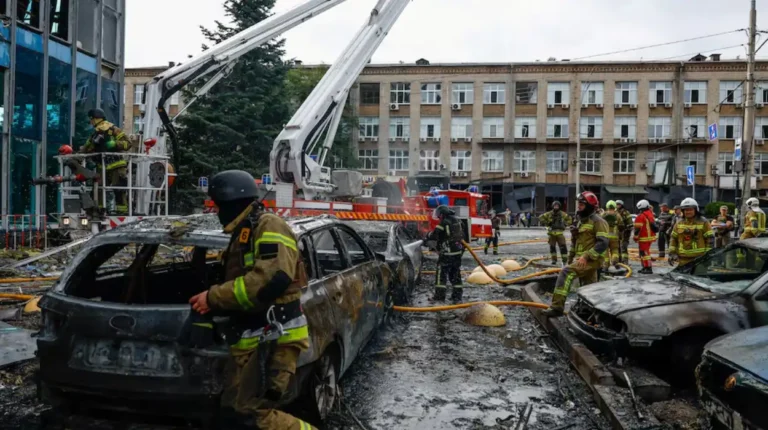
The regional administration of Russia stated that there were no victims or casualties of the attack, despite the fact that an emergency response team was sent to the scene. The Governor of Omsk region Vitaly Khotsenko stated that the drones were launched under daytime conditions and the preliminary information does not contain any casualties.
Russia’s government representatives argued that a number of drones was shot down prior to their reaching the target, which is a typical statement made by Russian authorities during cross-border attacks or deep strike operations. At the same time, the fact that a big refinery plant located in Siberia became a subject to attention indicates that the defense system was not completely successful. It is reported by Ukrainian as well as independent sources that an attack took place and fire was observed at the facility. The discrepancy between the two statements is important in terms of the evaluation of Russian air defenses efficiency.
Ukraine’s message: long reach, long pressure
From Kyiv’s perspective, the strike serves a dual purpose: operational and psychological. Operationally, it targets a strategic energy asset that supports Russia’s fuel supply chain, especially at a time when the Kremlin is trying to sustain its war economy under sanctions and battlefield strain. Psychologically, it tells Russian civilians, administrators, and industrial planners that no region is truly safe from the war anymore, not even Siberia.
Ukrainian President Volodymyr Zelenskyy later described Siberia as “within reach”, framing the attack as evidence of a new range of Ukrainian capability.
It is crucial since it is not merely an expression of pride; it is also a political gesture directed both domestically and internationally. In the domestic sense, it reiterates the message that Ukraine has the ability to make Russia pay despite the discrepancy in scale and armament. Internationally, it demonstrates that Ukraine is looking for the support since it believes that better air defenses and enhanced strike capability are needed to shift the war dynamic.
Furthermore, the Ukrainian army positioned the strikes against the Omsk refinery as the part of a broader offensive against Russian energy infrastructure. Reports suggest that Ukraine announced that the Omsk refinery was the last of the 11 biggest gasoline manufacturers in Russia being targeted in this campaign. If true, such statement implies a strategic move since Ukraine intends to undermine the refining capacities, make maintenance harder, cause disarray in fuel supplies, and make Russia defend a greater area with minimal air defenses.
Why refineries matter in war
But, importantly, refineries are not merely industrial infrastructure; they are logistical arteries. By refining crude into gas, diesel, aviation fuel, and other consumables used in logistics chains, transport systems, civilian energy use, and military logistics, attacks on them during a protracted conflict may lead to further consequences from localized destruction and stoppages through shortages and price spikes. And while even the briefest of outages in production will require expensive efforts to repair, inspect, and reassign forces, the true strategic value of the Omsk strike lies above and beyond its deep strike nature.
For Russia’s oil industry continues to form the very basis of state income, transport capabilities, and energy independence, and thus attacks on refineries can have an impact going far beyond their direct area of destruction. Practically speaking, Ukraine is proving that it can force Moscow to divert resources into air defense, repair, and increased security measures for facilities once considered well out of reach of the conflict.
Deep-strike warfare is changing the map
This incident also reflects a broader shift in the Ukraine war: the map of vulnerability is expanding. Earlier in the conflict, the logic of distance protected much of Russia’s interior. That logic is now weakening as drone technology improves, range increases, and Ukraine adapts its strike planning. Reports in recent weeks have already indicated Ukrainian strikes on other Russian energy facilities deep inside the country, including sites in Tyumen and other regions. The Omsk strike fits that pattern and suggests a deliberate campaign to turn Russian energy infrastructure into a persistent target set.
This matters for military analysts because it alters resource allocation. Russia must now defend not only frontline military sites and border regions but also interior industrial infrastructure thousands of kilometers away. That stretches air defense systems, radar coverage, and response capacity. It also forces commanders to confront the possibility that even low-cost drones, when used at scale and with enough range, can produce high-value disruption.
The information battle around the strike
Similar to other cases of conflict, the Omsk strike is also a contest of information. Ukrainian sources highlighted the success and the range of the strike, while Russian sources put stress on interception and minimization of damage. Both sides have certain motives for presenting this event in their own way. Ukraine needs to show capability and strategic genius of the military operation, while Russia needs to demonstrate its control over the situation and ability to defend itself.
This explains why the most reliable information can be obtained when triangulating from different signals – official statements, satellite data, reports of emergency services, and information of independent media. In this particular case, such combination of claims regarding fire, importance of the oil refinery, and range of the strike makes it impossible to treat this event as propaganda. At least, it seems to be a major strike that penetrated deeply into the Russian territory and hit one of the key fuel facilities.
What the strike means for Russia
The issue that Russia faces in the present case is not just the evaluation of the damage but also the confidence of the nation in terms of security. In fact, the strike carried out by the Ukrainian army on Russia’s largest oil refinery located in Siberia is embarrassing for a nation that had been claiming to have developed a secure military system and also to be geographically safe from foreign intervention. In addition to that, there is the political angle. Attacks occurring far away from the borders have the potential to disturb the people in a manner that would be different from attacks occurring at the borders. People living in the interiors of Russia may start feeling the effects of the war, which will change the perceptions of the people slowly despite the fact that the Russian government controls the majority of the media discourse within the country.
What the strike means for Ukraine
For Ukraine, the attack is a demonstration of range, persistence, and ingenuity. It reinforces the argument that battlefield success is no longer confined to trench lines or artillery corridors. Instead, it can be achieved through asymmetric pressure on logistics, energy, and infrastructure. If Ukraine can continue striking key industrial targets deep inside Russia, it may force Moscow into a more defensive posture and widen the costs of sustaining the war.
There is, however, a larger strategic risk. As Ukraine expands long-range attacks, Russia may respond with intensified strikes of its own, claiming justification through escalation. That means every successful Ukrainian deep strike has both tactical value and escalation potential. Still, from Kyiv’s perspective, the military logic is straightforward: if Russia’s rear areas are vulnerable, then the war becomes more expensive for Moscow and less predictable in its own territory.