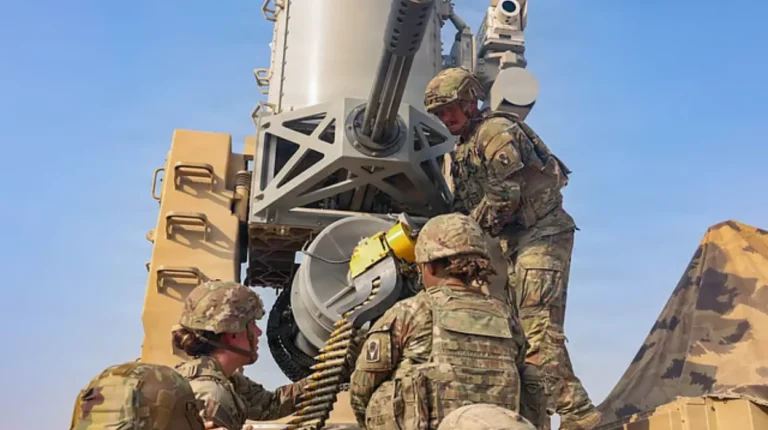
While the US has pulled out many of its forces from Nigeria in connection with a counter-terrorism collaboration effort in the Lake Chad Basin, there is no indication that Washington has completely severed its security relations with Abuja. The sharing of intelligence, provision of training, and military cooperation efforts are reportedly going on as per the claims made by both parties, indicating that the move is a partial withdrawal on the part of the Americans. This development is important due to the fact that it is happening when Nigeria’s anti-terrorism strategy is at a critical juncture.
The Lake Chad Basin region represents one of the most complicated security situations in West Africa, with terrorist groups like Boko Haram and the Islamic State posing challenges in the region. In light of such circumstances, the recent American withdrawal has invited debate over whether Nigeria will be able to maintain its pace without any American help.
A mission described as successful
It is significant to note how the US administration has described the withdrawal as the accomplishment of a certain mission as opposed to a withdrawal from Nigeria and the entire region. This is based on information that indicates the joint operation started in December last year and was described as a success by the US. The success is based on a campaign that degraded the Islamic State leadership in Nigeria to the extent that there was no further need for the size of the deployed forces since the threat had been neutralized.
The reason why this is significant is the fact that it implies that the US administration had a very specific mission and hence a goal-oriented operation that will eventually come to an end. This implies that the withdrawal is selective.
What was withdrawn
The available reporting makes clear that the troops withdrawn were those associated with the Lake Chad Basin mission. These forces were part of a joint operation aimed at supporting counterterrorism efforts against extremist groups operating in and around northeastern Nigeria. Their removal is therefore operationally significant, but it does not mean all American military personnel have left the country.
Nigerian defence authorities said the troops pulled out of the Lake Chad mission should not be confused with other US personnel still in Nigeria. The Defence Headquarters clarified that
“200 US troops still [are] in Nigeria for joint intelligence, training”
and that these are distinct from the forces withdrawn from the field operation. That distinction is central to understanding the story: the withdrawal affects one mission, but intelligence and training cooperation continue through another channel.
Abuja’s response and assurances
The official Nigerian stance has been very carefully crafted so as to create the perception that it is not a setback strategically for Nigeria. Indeed, the military officers have assured that this move will not interfere in any way with the ongoing security operations and have expressed their confidence that the Nigerian military will still be able to take care of business.
The quote by the Nigerian authorities, “not affect our momentum in any way,” is an expression of the political reality that Nigeria finds itself. Indeed, this quote expresses the balance that exists in Nigeria when it comes to its security operations and the politics of it all. On one side, there is the desire to maintain good relations with Washington and to be seen not to be too dependent on foreign troops. At the same time, they have to assure their citizens that there will be no weakness in their operations against the insurgents.
Intelligence cooperation remains central
Despite having pulled out almost all of its troops, intelligence coordination takes center stage in the US-Nigerian security partnership within this context. This is very important considering that modern day counterterrorism has moved away from the traditional approach whereby large numbers of troops are used and towards approaches that focus on surveillance, information sharing, targeting, and training. Within a theater such as the Lake Chad Basin region, whereby militant groups take advantage of the geographical terrain and mobility as well as social networking to conduct attacks, intelligence assistance can be as important as putting boots on the ground.
The continued intelligence coordination also mitigates any potential damage caused by the troop withdrawal since it clearly shows that the US is not withdrawing from the counterterrorism network in Nigeria but rather reconfiguring its role within this structure.
Why the Lake Chad Basin matters
The Lake Chad Basin is not just a typical conflict area; it is a regional security fault line between Nigeria, Niger, Chad, and Cameroon. The armed groups in this region have used the weakness of border control, local frustrations, and the tough topography to maintain their insurgent activities for decades. Any shift in the external military support, therefore, is no small matter since it has impacts on regional coordination, intelligence gathering, and the tempo of the counter-offensive campaigns. This is what makes the US drawdown interesting to security analysts and journalists alike.
While some experts regard it as a way to measure how well Nigeria can continue its fight against the terrorism independently, others suggest that if the intelligence and training partnership is strong enough, there is little to worry about. Both assessments, however, point to the same truth that the operation involves not only military capabilities but also intelligence and political factors.
Diverging interpretations
The reaction to the US move has been mixed, and that is unsurprising. Supporters of the drawdown argue that a successful mission should end with a reduction in foreign troop presence, especially if local forces are better positioned to take over. From that perspective, the US has done its part and is now shifting to a lower-profile partnership that respects Nigerian sovereignty while maintaining cooperation.
Critics, however, worry that the drawdown could expose gaps in Nigeria’s counterterrorism readiness. Reports have cited concerns among security experts that the country may face challenges if it has to absorb the full burden of operational planning, intelligence collection, and field coordination without robust external backing. That concern does not necessarily mean the withdrawal is wrong, but it does underline the pressure on Nigerian institutions to prove that they can maintain tempo and effectiveness.
The strategic message from Washington
What is implied by this policy from Washington, however, is that this is merely a repositioning rather than an abandonment of the strategy altogether. This way, the US is able to continue to maintain intelligence cooperation with Nigeria despite reducing its military presence there. Moreover, this policy corresponds to the general trend in many security partnership arrangements which involve the transition from direct involvement and intervention towards advising, training, and intelligence cooperation. It works well for the United States because this strategy requires less financial commitment and entails fewer political risks for Washington. At the same time, the strategy remains beneficial for Nigeria as long as the role of the frontline fighter falls on the shoulders of the local military rather than on the shoulders of foreign troops.
What the figures show
The clearest number in the reporting is the reference to 200 US troops still remaining in Nigeria for joint intelligence and training purposes. That figure matters because it shows that the US presence has not disappeared; it has been narrowed and repurposed. It also indicates that any public discussion of the withdrawal should avoid suggesting a total military exit.
Another key figure is the timing of the operation, which reportedly began in December last year. That timeline suggests the mission was relatively short by counterterrorism standards, strengthening the argument that it was conceived as a bounded deployment. The reported description of the operation as a success further supports the view that Washington believes the mission achieved its immediate objectives.
Political and security implications
For Nigeria, a partial withdrawal means both challenges and opportunities. The challenge is evident since the country has to prove its ability to put operational pressure on insurgents without becoming overly dependent on foreign troops. Opportunities for the country are also evident since a successful change will indicate increased self-sufficiency while still retaining intelligence and training. From the point of view of the US, the partial withdrawal will help redefine its involvement in the process. Without being directly involved in the operation, the US government can still influence the situation through the cooperation and information exchange. This may be politically expedient if the operation is deemed already accomplished.