The latest statements made by Benjamin Netanyahu represent one of the most direct signals from Netanyahu regarding the need to lessen reliance on U.S. military aid and develop an increasingly independent military-industrial complex. Rather than viewing the move as a confrontation with Washington, the Israeli Prime Minister described it as a strategic decision dictated by war and regional threats, as well as the need for independence. In essence, Netanyahu’s statements are an expression of the belief that the country possesses the capability to operate independently of Washington, despite the potential risks associated with this decision.
This message is conveyed at a time when there are clear signs of tension within the larger context of the relations between the United States and Israel during President Donald Trump’s presidency despite the strong ties existing between the two nations on many security issues. From Netanyahu’s perspective, what Israel hopes to achieve is to maintain its alliance with the U.S. without making itself too reliant on America’s political decisions in terms of its defense capacity.
What Netanyahu said
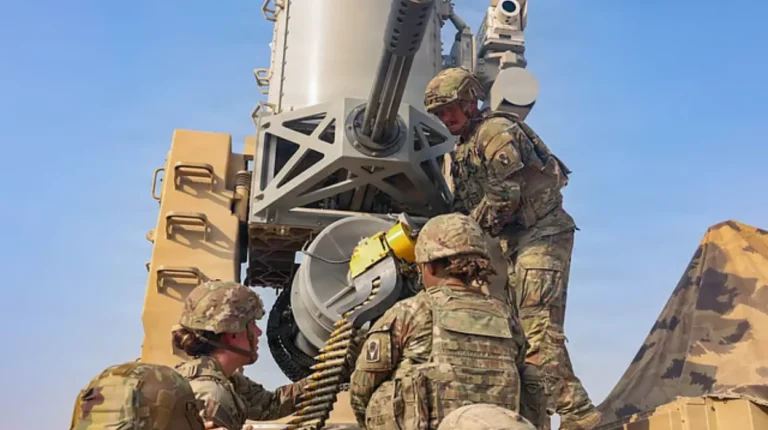
Netanyahu’s central argument is that Israel has reached a point where it should no longer rely so heavily on imported military aid and should instead expand domestic production of weapons and defense systems. He presented this as a matter of national resilience, describing Israel as having “come of age” in military and industrial terms, according to reporting on his remarks.
He also reportedly said Israel should
“reduce military support within the next ten years”,
and when asked whether that meant bringing U.S. military assistance down to zero, he answered in the affirmative, at least with regard to the financial component of aid.
It is important to highlight the fact that it is not an empty declaration, but rather a goal that Netanyahu has set for the future. In addition to that, it is important to state that Netanyahu is presenting the decision in such a way that it implies that the process is not going to be immediate. Based on the analysis of the report, it seems that the Prime Minister plans to work together with the United States and to develop the nation’s manufacturing industry. This is a critical aspect to focus on when it comes to the interpretation of the political message.
Why now
The timing is intimately linked to the prevailing political and security situation. Israel continues to operate in a regional environment that is influenced by the dynamics of warfare, deterrence, missiles, and wider uncertainties associated with Iran and its proxies. In this regard, one can see Netanyahu’s statements as a position which states that a nation under continuous threat cannot afford overdependence on just one partner.
Moreover, these statements were made in a context of rising tensions between the Israeli government and the Trump administration with regard to the handling of regional crises and the setting of strategic priorities. It has been noted that these may relate to disagreements over policy on Iran and other issues which affect Israel’s leeway. Even if the disagreements cannot be viewed as a complete shift in the policy of the country, this seems to have increased Netanyahu’s resolve to minimize exposure to potential changes in US politics in the future. This statement can also be seen as a domestic political message. Netanyahu is able to make statements of self-sufficiency in order to appeal to those Israelis who value strategic autonomy and military innovation.
The money behind the plan
One of the most concrete figures attached to the plan is the reported 350 billion shekels, or roughly $110 billion, that Netanyahu has tied to developing an independent arms industry. That number gives the proposal weight beyond rhetoric. It suggests an ambitious, multi-year industrial and procurement effort rather than a short-term political talking point.
Such a move would probably involve several levels of the Israeli defense ecosystem – from weapon production and R&D to supply chain management and procurement processes. Also, such a commitment is meant to prevent any chance of having the delay, imposition of certain conditions, or even disputes in Washington undermine defense requirements of Israel. Thus, the concept implies a long-term solution – creation of the appropriate capabilities which will allow Israel to produce, operate, and maintain systems without external assistance. At the same time, self-reliance does not mean that it is enough just to produce things locally because even most advanced industries need foreign technologies, development cooperation, and procurement process. Therefore, when Netanyahu discusses the end of reliance, it should be considered as a strategy and not the actual termination of all contacts.
U.S.-Israel ties in context
The U.S.-Israel security relationship remains deeply rooted, and recent reporting suggests that the Trump administration has not pulled back from military support in a major way. In fact, some accounts say Washington has accelerated arms sales and transfers to Israel and has generally avoided pushing back on Israeli military actions in the region. That makes Netanyahu’s comments especially interesting, because they are being made inside a relationship that is still active and militarily close.
Also noteworthy is the political aspect of the relationship. While the current Trump administration is no stranger to exceptional levels of support for the state of Israel, it appears that disagreements persist on matters such as Iran and tariff rates and others. The need for reduced dependency can thus be seen as being driven by some defense against a potential loss of security. In that respect, the comments made cannot be viewed simply as being about the acquisition of military equipment. They relate more to power and timing and having the option to make decisions that don’t depend on approval from elsewhere.
What the comments signal
Netanyahu’s statement sends two messages at once. The first is reassuring to Israelis who want to know that the country is preparing for long-term strategic uncertainty. The second is reassuring to Washington in a different way: it says Israel is not abandoning the alliance, only trying to become less vulnerable inside it.
That dual messaging matters because Israel cannot easily replace U.S. military support overnight, and Netanyahu almost certainly knows that. U.S. aid and cooperation have helped shape Israel’s air defense, strike capability, and broader defense posture for decades. Any real move toward reduced dependence would take years, large public investments, and a deliberate industrial strategy.
Still, the political symbolism is powerful. A prime minister publicly saying Israel should ultimately free itself from arms dependence on the U.S. is an assertion of confidence and a warning at the same time. It tells supporters that Israel is strong enough to stand on its own while signaling to the U.S. that Israeli security choices should not be taken for granted.
Broader implications
If Netanyahu’s vision were seriously carried out, then this can have huge repercussions for both Israel’s defense economy and diplomacy. In terms of economics, there will be increased focus on manufacturing within Israel, research and development, and increases in procurement expenditure on defense. In terms of diplomacy, this may be interpreted to mean that Israel wants increased independence while still remaining close allies of the United States.
It could also affect how future U.S. administrations approach military aid debates. If Israel is seen as progressively less dependent, critics of large-scale assistance may gain a new argument, while supporters may say the alliance is evolving in a healthier, more balanced direction. Either way, Netanyahu’s comments keep the question of aid, leverage, and strategic autonomy at the center of the bilateral relationship.
For now, the key point is that this is a long-term declaration, not a completed policy shift. Netanyahu is setting out a destination: an Israel that can produce more of what it needs and withstand greater external pressure. Whether the political system, defense establishment, and industrial base can deliver that outcome remains the larger question.