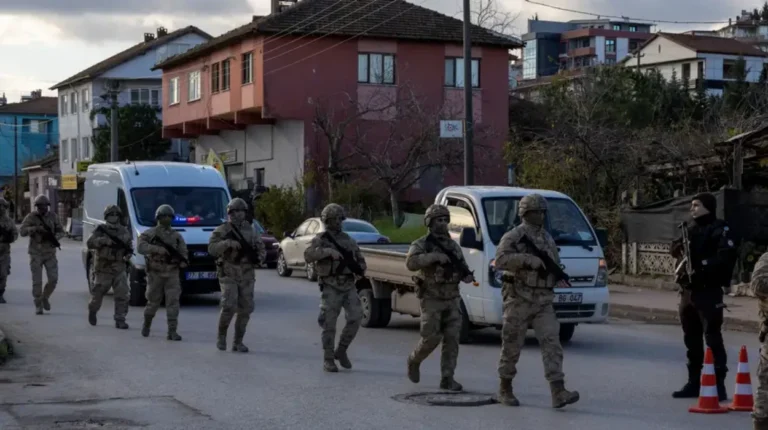
Ankara has been actively pursuing its counterterrorism strategy against the Islamic State group through its ongoing efforts to detain 115 suspected ISIS members in coordinated raids across the country.
The security operation occurred before Christmas and New Year’s because it demonstrates how people now understand security threats better after going through traumatic events and their ten-year fight against ISIS networks, which operate in Turkey and its border regions.
The Istanbul Prosecutor’s Office issued arrest warrants for 137 suspects based on intelligence reports which revealed ISIS planned holiday season attacks against public events, and non-Muslim groups. The domestic counterterrorism operations in Turkey executed multiple raids across different provinces which resulted in arrests. This proves the strength of their coordinated operations.
Why is Türkiye uniquely exposed to ISIS activity?
Turkey operates in a special way during the worldwide fight against ISIS. The group emerged in 2013–2014. This made Turkey face continuous security risks because it shares borders with Syria and Iraq, where ISIS maintains its main operational bases. ISIS established secret operational units which handled recruitment, funding, logistical support, and attack operations although the group never controlled any territory within Turkey.
ISIS launched several large-scale deadly operations against Turkish territory between 2015 and 2017 which increased the level of danger. The attacks consisted of the October 2015 Ankara peace rally bombing that caused over 100 deaths, and the January 2016 Sultanahmet suicide bombing, which targeted international visitors, and the 2015 Suruç bombing that ended 33 lives.
The most lethal attack took place at Istanbul’s Reina nightclub on New Year’s Eve 2017 when an ISIS gunman killed 39 people. Turkey’s counterterrorism approach underwent a major transformation because of these attacks. This resulted in a shift from reactive law enforcement to proactive intelligence-based disruption methods.
During the most recent raids across 124 locations in the country, authorities seized pistols, ammunition, together with documents which they identified as ISIS organizational materials. The suspects maintained their international connections by staying in touch with ISIS members who were active in war zones, according to prosecutors, even after the group lost control of Syrian and Iraqi territories.
Turkish officials stated that the operation functioned as a preventive measure instead of a reactive response. Intelligence reports indicate that ISIS agents planned attacks during symbolic dates, and crowded public areas connected to Christmas, and New Year’s celebrations to create the most psychological impact.
The ongoing operations to capture the remaining suspects show that the threat continues to be active and persistent.
The Turkish government has detained over 10,000 people with ISIS ties throughout the last ten years. The Turkish Interior Ministry, together with parliamentary briefings, showed that authorities detained over 40,000 ISIS suspects between 2015 and 2024. The anti-terrorism legislation in Turkey led to the formal detention and prosecution of thousands of people.
The Turkish security forces destroyed more than 100 ISIS cells which conducted recruitment and funding operations. The group made counterfeit papers. They took control of border checkpoints. Turkey deported or refused entry to more than 9,000 foreign terrorist fighters who came from more than 100 different nations.
Turkey has conducted numerous major military operations beyond its national borders. Through operations such as Euphrates Shield (2016–2017), and following cross-border campaigns in northern Syria, Turkish forces played a vital role in removing ISIS from border areas, which cut off the group’s access to supply lines and operational depth.
Turkey operates an integrated counterterrorism system which unites intelligence operations with law enforcement activities, prosecution procedures, and border protection functions. The nation holds the most detailed counterterrorism legal system in the entire region which allows officials to capture suspects based on intelligence evaluations. It stops their plans before they take place.
The year-end period stands out as a time when security threats reach their highest point. The Turkish police expand their monitoring operations by creating extra checkpoints and performing more frequent raids throughout every major public celebration, national holiday, and anniversary. The authorities state that these measures have stopped major attacks with numerous victims from occurring during the past few years.
Is ISIS still capable of large-scale attacks in Türkiye?
ISIS lost its control over its territorial “caliphate” in 2019, but the organization continues to operate. The organization now operates through decentralized methods, which include independent cells and solitary actors who radicalize people through digital platforms. The security agencies in Türkiye believe ISIS remains active in planning symbolic attacks to regain influence through targeting minority groups and civilian populations.
The prosecutor stated that suspects aimed to harm non-Muslim people. This shows ISIS’s religious-based violent approach that targets different faith groups to create social fear and division.
The operational field of counterterrorism continues to function as a dependable area for collaboration between Western states, even though political disagreements exist between them. Turkish officials highlight the importance of early intelligence sharing because most ISIS plans that European authorities stopped originated from routes passing through Turkish border areas.