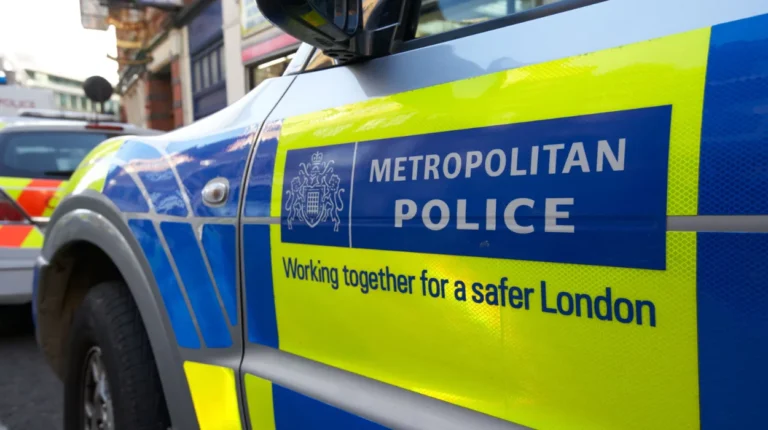
The 28 April 2026 suspected arson attack in London has garnered attention for its location and symbolism. The blaze at a memorial wall in Golders Green, a neighbourhood with a significant Jewish population, has led to an investigation by police counter-terrorism units. While the fire did minimal damage and no one was hurt, its deliberate nature has thrust it into the category of “terrorist” acts.
Police have confirmed that the blaze started from a nearby memorial table and quickly spread, with initial indications that an accelerant was used. The inclusion of counter-terrorism policing at a preliminary stage is a preventative measure in line with recent attacks on public spaces and symbols. While the case may not be designated as terrorism, the apparent motive has put the attack within a security context.
Police response and investigative positioning
The Metropolitan Police has dealt with the matter with unmistakable caution, stressing that the motive is still being investigated, but that there is an increased level of community interest. The police response is being coordinated by Counter Terrorism Policing units with local police officers, suggesting an intelligence-driven response rather than a typical arson investigation.
Police have reiterated the need for an “open mind”, a term that connotes not only a lack of preconceived ideas, but also a recognition of the event’s significance. This is a balance between “not jumping to conclusions” and “seeing the forest from the trees”, as Jewish sites have been targeted in a number of recent incidents.
Expanding use of counter-terror frameworks
The deployment of counter-terrorism units in cases where there is no terrorism classification is an example of a shifting model of policing. Police are increasingly throwing more resources at incidents where there is a major impact on community safety, despite their non-terrorist classification. This approach enables greater intelligence collection and case comparisons.
Community reassurance as operational priority
Reassurance is another feature of police statements, with police leaders citing such events as having “heightened concerns” in the community. The deployment of security resources provides a public display of counter-terrorism measures, not only for investigation but also as a reassurance measure. In an environment where fear can be contagious, “spinning” is part of the policing.
The memorial wall as a contested symbolic space
The targeted site in Golders Green holds a multiplicity of meanings not only in its materiality. It honours the victims of the Iranian government’s response to the protests, and the victims of the October 2023 Hamas attack in Israel. The site is thus the site of multiple geopolitical and ideological messages.
These memorials are often sites of collective memory, but can also be hotspots in polarised settings. The seeming focus of the attack, the memorial, is an attempt to undermine the narratives by physical action, rather than through large physical damage.
Overlapping political narratives
The memorial’s focus on both Middle East politics and diaspora communities in the region connects it to both the region’s political struggles and local politics. For some, this might be an expression of anti-Semitism; for others it could also be a response to particular political messages the site communicates. This makes the question of motive difficult to discern and highlights the complexities of symbolic attacks.
Symbolism as a force multiplier
Even seemingly minor destruction can have profound psychological and social impacts when the object of the attack is symbolically important. Here, the attack reverberates beyond Golders Green, adding to the perception of vulnerability felt by those that see a connection to the memorial’s message. That’s why we see events such as this treated with disproportionate gravity given their limited size.
Pattern of incidents and broader security concerns
The Golders Green arson incident is one in a string of events reported since the beginning of 2026 that have targeted Jewish-linked places in London. These range from graffiti to attempted arson and attacks on community assets, such as fire appliances used by local groups. The cluster of incidents has prompted officials to weigh up whether they are part of a pattern or a case of spontaneous attacks.
Recent events are leading analysts to view this as a “new normal”. In place of high-profile, high-casualty actions, recent events indicate a shift towards more symbolic and fear-inducing actions.
From isolated acts to systemic patterns
The concentration of actions in particular locations prompts questions about causes. Although individual cases may have different motives, the overall impact is a feeling of pressure on the affected communities. This can be a byproduct of the actions, enhancing their effect.
Influence of global tensions
Global events, such as conflicts and disputes, have also had an impact on local politics, such as in London. The situation in the Middle East, including the conflict between Iran and Israel, has led to heightened tensions and polarisation. Given the memorial’s association with these issues, it is particularly susceptible to “targeting”.
Counter-terrorism strategy and evolving legal thresholds
The Golders Green attack is part of a growing trend in UK security policy which sees distinctions between terrorism, hate crime and political violence being conflated. The use of counter-terrorism resources at the early stages seeks to tackle threats in a holistic way, even when they may not meet the legal definition of terrorism.
This strategy is beneficial in terms of efficiency and intelligence gathering, but it also presents challenges of proportionality and powers of counter-terrorism. The issue is striking a balance between increased security and respect for civil rights, while avoiding over-policing.
Intelligence-led policing and prevention
Today’s counter-terrorism focus is on prevention rather than reaction. In instances such as Golders Green, police can work out links between events and networks. This approach is based on past failures to perceive threats.
Legal and ethical considerations
However, the application of counter-terror measures in marginal cases needs to be justified. Some claim broadening the use of such powers will sanction extraordinary powers for routine crime. Policy makers must thus balance security and the rule of law.
Implications for communal security and public trust
The immediate impact of the arson extends beyond physical damage to questions of safety and belonging within affected communities. Reports of increased anxiety among Jewish residents in London and other cities suggest that the cumulative effect of recent incidents is shaping perceptions of security.
Authorities face the dual task of addressing the specific case while also responding to broader concerns about communal vulnerability. This involves not only investigative work but also engagement with community leaders and the reinforcement of protective measures.
Reassurance through visibility and engagement
Visible policing, combined with communication efforts, plays a key role in restoring confidence. By maintaining a strong presence and providing regular updates, authorities aim to demonstrate commitment to protecting vulnerable groups. This approach recognizes that trust is as important as enforcement in maintaining stability.
Long-term challenges for social cohesion
The recurrence of symbolic attacks poses a challenge to social cohesion in diverse urban environments. If such incidents become normalized, they risk deepening divisions and undermining the sense of shared public space. Addressing this challenge requires not only security responses but also broader societal efforts to counter polarization.
The Golders Green case illustrates how a single incident can encapsulate wider tensions within contemporary urban security landscapes. As investigators continue to examine the motives and connections behind the arson, the outcome may shape how similar cases are approached in the future. The interplay between symbolism, security, and community resilience remains a defining feature of this evolving threat environment, raising enduring questions about how cities can protect both their physical spaces and the meanings attached to them.