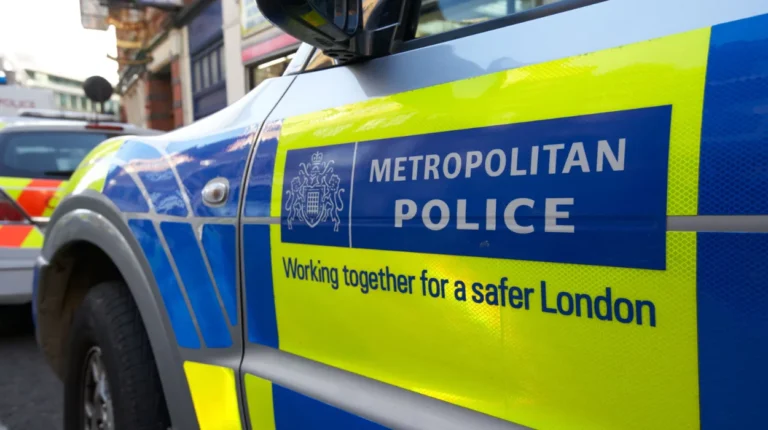
During the early morning hours of Tuesday, 5 May 2026, flames could be seen licking at the empty walls of an abandoned synagogue located in the Whitechapel area of east London, once again sparking fears of the relationship between antisemitism, arson, and terrorism across the country. The incident at the abandoned East London Central Synagogue has been classified as suspected arson and is currently under investigation by the Metropolitan Police’s Counter Terrorism Command.
The fire started shortly after 05:00 BST when the firemen arrived to discover that the building was fully ablaze from the smoke. The London Fire Brigade stated that there were no casualties, and the building was not being used for religious services at the time. Yet the fact that the structure had once served as a Jewish place of worship and that CCTV evidence suggests the fire was deliberately started has turned a local incident into a counter‑terrorism‑led inquiry.
Open Source Intel said in X post,
“NEW: A former London synagogue was targeted in a suspected arson attack early Tuesday, according to the Metropolitan Police. Minor damage was reported to the gates, no injuries. CCTV indicates the fire was deliberately set before dawn.”
NEW: A former London synagogue was targeted in a suspected arson attack early Tuesday, according to the Metropolitan Police. Minor damage was reported to the gates, no injuries. CCTV indicates the fire was deliberately set before dawn.
— Open Source Intel (@Osint613) May 5, 2026
A pattern of fires targeting Jewish sites
The Whitechapel arson sits within a broader wave of attacks on Jewish‑linked properties across London in the first half of 2026. However, these attacks are no longer seen as mere vandals’ work, but as part of a series of arson attacks targeting Jews in the country with the aim of instilling fear among the community.
A synagogue in north-west London, Kenton United Synagogue, was attacked through arson on 18 April 2026, resulting in some smoke damage to an inside room. The teenager, aged 17 years, is pleading guilty for committing arson without endangering anyone’s life. This shows the link between youth extremism and antisemitism in the city.
Simultaneously, there have been several incidents where arson or attempted arson offenses have occurred at synagogues or other buildings associated with the Jewish community located in Golders Green, Finchley, and Hendon. In one such case, accelerant-filled bottles were hurled at a synagogue but failed to ignite, demonstrating the combination of unskilled and well-planned methods utilized.
Moreover, on 23 March 2026, an arson attack against an anti-Semitic hate crime took place against ambulances, which were set on fire at a Hatzolah center that was connected to a local synagogue in Golders Green. Hatzolah is a voluntary organization providing emergency medical assistance, which is well-known as an emblematic target of any anti-Semitic hate group. The above attack represented a change in targeting from desecrating buildings to endangering emergency response capability. Lastly, an attempt at arson attack against a Jewish memorial wall in north London was considered a terrorist-related offense.
Community and local leadership response in Tower Hamlets
With the developments at Whitechapel, local political figures were quick to react condemning the attack. In Tower Hamlets where the former East London Central Synagogue is situated, the area’s future mayor and Aspire candidate Lutfur Rahman condemned the attack on X.
Rahman said in X post,
“I am deeply shocked and saddened by this appalling antisemitic attack on the former East London Central Synagogue – a building which was sold after the synagogue had closed. I urge anyone with information to contact the police by calling 101. I have contacted representatives from the former synagogue to offer my wholehearted support, and I send my solidarity with the wider Jewish community. There will be increased visible patrols by the police and our Tower Hamlets Enforcement Officers to reassure our residents. Tower Hamlets has a proud history of standing united against all forms of hatred and bigotry, from the Battle of Cable Street to today, and we will not tolerate any attempt to intimidate or threaten the local Jewish community.”
I am deeply shocked and saddened by this appalling antisemitic attack on the former East London Central Synagogue – a building which was sold after the synagogue had closed.
— Lutfur Rahman (@LutfurRahmanTH) May 5, 2026
I urge anyone with information to contact the police by calling 101.
I have contacted representatives… https://t.co/Eymf96mdio
However, the importance of this particular intervention extends beyond its political implications into an implicit statement that the authorities are seeing this case as an attack motivated by antisemitism, and not simply as a criminal activity. The use by Rahman of the example of the Battle of Cable Street – a historical instance of communal resistance to fascism – links the Whitechapel fire to the tradition of Tower Hamlets resisting hate in its various forms, including counter-terrorism messages.
Counter‑terrorism policing at the centre of the response
The way the UK counter‑terrorism police have framed and responded to these incidents reveals a reframing of what counts as a security threat in today’s urban environment. With the increasing incidences of fires in synagogues, not only has the Counter Terrorism Command of the Metropolitan Police taken charge of the Whitechapel affair but also cooperated with commanders from various boroughs as well as intelligence services from London.
According to DC Superintendent Brittany Clarke, who is leading the investigation in East London, the whole event is handled “with utmost seriousness.” The counter-terrorism units are looking into all the possible causes, including hatred and extremism. Senior national coordinator Vicki Evans warned that the recent attacks “share a similar nature” and indicate
“targeted animosity toward Israeli‑ and Jewish‑linked locations.”
In each of the series of cases, there have been arrests of at least 15 people for charges of terrorism or arson. Seven to eight people have been arrested on charges of arson, and these include adult and juvenile suspects, among whom is the 17-year-old who admitted guilt in the Kenton Synagogue bombing incident.
This combination of different ages and legal classifications brings into light one of the major issues for police counter-terrorism: differentiating domestic hate-crime offenders from ideological extremists, who in some cases might be loosely associated as opposed to officially aligned. The Whitechapel case is being investigated as a possible hate-inspired and/or ideological attack by the police, but so far it has not been labeled a terrorist attack according to the Terrorism Act of 2000.
Community fear, political reaction, and the security‑funding debate
For the Jews of London, the situation has led to an acute feeling of vulnerability. The Community Security Trust (CST), which is the leading Jewish security watch organization in Britain, has time and again requested that the police increase their presence outside synagogues, community centers, schools, and Jewish cemeteries. Additionally, in recent press statements, CST officials have alleged that the British government has not provided sufficient security resources for Jewish places of worship.
The Chief Rabbi, Sir Ephraim Mirvis, has described the attacks as “cowardly” and warned that British Jews are experiencing a “wave of violence and intimidation.” He has pressed authorities to treat the arson surge not merely as a law‑enforcement issue but as a societal and security challenge requiring sustained investment in protection and prevention.
In the political sphere, Prime Minister Keir Starmer has issued a harsh condemnation of the incidents and has promised increased patrols near Jewish centers. The British Prime Minister also ordered a review of the funds allocated for security measures and the processes for intelligence sharing among the government, police force, and Jewish organizations. This shows that the authorities understand that the risk environment has shifted from conventional terrorism to arson motivated by ideology.
It has been publicly stated by security agencies that there is a history of Iran making attempts to use criminals as proxy agents for conducting hostile actions within the UK. But it needs to be noted here that any such assertions made on the internet need not be necessarily taken as true facts. In addition, all associations with foreign entities, including those from Iran, have been under close scrutiny.
Intelligence angles: Iran‑linked groups, online claims, and domestic extremism
Among the key areas of sensitivity related to the Whitechapel arson case is the possibility of any link to Iran-backed or proxy organizations. There are investigations underway to determine if there is any link between the organization called Harakat Ashab al-Yamin al-Islamia, which has Iranian backing, and the arson acts. This organization has been responsible for setting fire to synagogues and has taken credit for it on the internet.
Nevertheless, there is a warning from government officials that these kinds of statements can actually be a form of propaganda, which can be used to exaggerate their influence or even deliberately confuse investigators. According to Vicki Evans, as well as other high-ranking counter-terrorism officials, the online rhetoric has been handled with great care, as they base their findings on forensic evidence, CCTV footage, and human sources.
Nonetheless, there is also the issue of domestic-hate-based extremism. The 17-year-old boy accused of torching the Kenton synagogue is viewed from the angle of a domestic-hate crime or the prospect of radicalization to extremist views, rather than an international terrorist. This is characteristic of the current UK stance on counter-terrorism, where the boundaries separating lone extremism, hate-related networks, and terrorism become blurred.
Counter‑terrorism analysts argue that the current wave of synagogue arsons embodies a “hybrid” threat model: attacks that are relatively low‑tech, often carried out by individuals or small groups, but whose impact is amplified by their symbolic value and their potential to trigger wider social polarisation. For counter‑terrorism police, the challenge is to prevent escalation without over‑securitising entire communities, while still ensuring that minority groups feel protected.
Statistics, trends, and the evolving security posture
From October 2023 onwards, antisemitic attacks across the entire country of the UK have seen a dramatic increase, corresponding to the eruption of the Gaza conflict and the emergence of pro-Palestinian and pro-Israeli demonstrations within the UK itself. In the case of London, there have been multiple arson attempts against Jewish targets, increasing from only a few scattered occurrences in 2023 and early 2025 to a series of five to six cases within March to May 2026.
This trend has influenced the way the Metropolitan Police and security agencies plan their resource allocation strategy. The authorities have dispatched hundreds of extra police personnel, including armed and counter-terrorism units, at synagogues and centers in east and north London. Stop-and-search provisions and improved CCTV surveillance have been utilized in selected boroughs, especially those with a history of arson attacks.
The lesson for the anti-terrorism community from the Whitechapel attacks is the need for the definition of terrorism to evolve along with the evolution in tactics used by those seeking to terrorize their target populations. Targeting derelict buildings that were once Jewish, ambulances, and memorial walls shows intent to intimidate even without the presence of congregants.
Police and community leaders are calling on people to alert the authorities about any suspicious behavior near Jewish establishments, particularly at night, and provide details that may help identify any surveillance activities or plans. The government has threatened harsh penalties, including terrorism-related jail terms, for anyone involved in plotting and perpetrating such attacks.
A test case for the UK’s counter‑terrorism strategy
The burning of the vacant synagogue in Whitechapel can be considered as an experimental case in which the effectiveness of the British counter-terror mechanism in dealing with small-scale but very symbolic attacks with ideological motivations is tested. The case will test whether the police forces are able to react quickly and prevent future attacks, whether the attack originates abroad or at home.
As the counter-terrorism branch of the UK’s police force carries out its investigation, it is crucial that the top-ranking officers do not declare the Whitechapel fire incident as a terrorist act while at the same time ensuring that every possible resource for counter-terrorism is brought into play. This approach signifies a new paradigm of counter-terrorism measures that is targeted and intelligence-based.