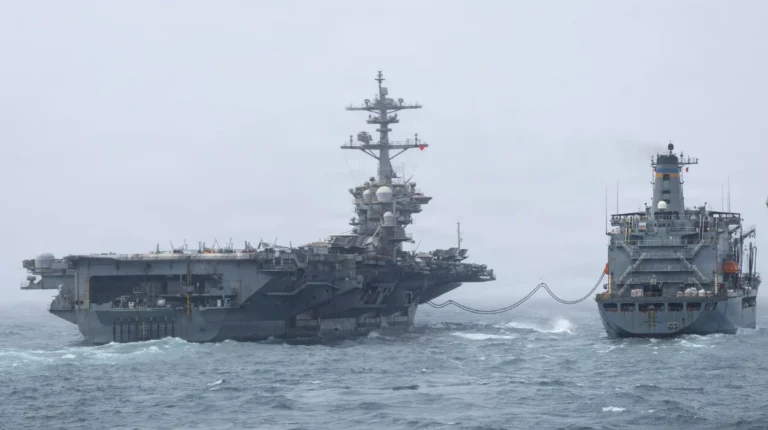
The latest wave of US airstrikes on Iran marks a decisive shift in the six‑day confrontation that has rapidly evolved from military containment to an emerging infrastructure war. Over six consecutive nights, US forces have moved from targeting strictly military assets to hitting bridges, electrical facilities, and a tower at a key Iranian port, in an explicit bid to pressure Tehran to ease what Washington describes as Iran’s chokehold on the Strait of Hormuz. At the same time, Iran insists that these are attacks on civilian infrastructure and has answered with strikes of its own on US‑linked locations in Syria and Bahrain, intensifying fears of a broader regional escalation.
US Central Command (CENTCOM) confirmed early Friday that it had completed its sixth straight night of strikes, describing “dozens” of targets hit across Iran. The most recent one, according to the threatening public rhetoric of US President Donald Trump, targeted infrastructure facilities that Washington believes are critical for the projection of Iranian power through the sea route through which a substantial portion of the world’s oil and energy supplies are shipped. These attacks, for Iran, constitute violations of international law and sovereignty, crossing over the border from being military provocations to economic and civilian disturbances.
At 2 p.m. ET today, U.S. forces began conducting a new wave of strikes against Iran for the sixth consecutive night to further degrade Iranian military capabilities.
— U.S. Central Command (@CENTCOM) July 16, 2026
Six Days of Strikes: From Military Assets to Infrastructure
The past six days have seen the use of a strategy that is progressive and yet escalating. The initial rounds of bombardment were geared towards military targets, such as command centers, coastal radar stations, air defenses, drones and anti-ship missile sites on the southern coastline of Iran and the Strait of Hormuz. US officials referred to this as precision bombing, with the aim of reducing Iran’s capability of attacking commercial vessels and regional bases.
Throughout the course of the operation, CENTCOM press releases continued to stress that the strikes carried out were proportional. However, with every passing night, the list of targets kept growing longer. Reports from the beginning of the week suggested that American forces had managed to destroy or disable many small IRGC naval vessels, sensor installations located along the coast, and logistic bases used by Iran for its maritime operations. By mid-week, it became increasingly clear that in case of no de-escalation of Iran’s activity in and around the Strait, the list of targets would be extended to include more than just military equipment. And so it happened on the sixth night.
US aircraft attacked not only several bridges, but also some electrical infrastructure and eventually brought down a tower in an important port city. It marked a shift in the character of the operation – from exclusively attacking equipment used to launch, sense, or guide weapon systems to equipment necessary for Iran’s larger economic and logistic presence in its southern coastline.
Targeting a Key Port and Its Tower
One of the significant landmarks targeted in the last wave is a crucial port in Iran which is considered by many to be a key port from where Iran accesses the waters of the Gulf of Oman. The strategic importance of the port is two-pronged since it not only acts as a gateway to Iran’s commercial activities but it is also a dual-use facility where the logistics and surveillance facilities are used by Iran to conduct military and paramilitary activities. In this scenario, the crumbling down of the high-rise tower of the port is of both operational and symbolic significance.
As per images and reports, the tower was an essential component of the functioning of the port, maybe associated with communications or navigation purposes. Despite the lack of detailed information as to the purpose of the tower, one cannot ignore the strategic intent behind the targeting of the tower as part of the broader mission.
For Tehran, the attack on the port tower and related infrastructure is portrayed as proof that Washington has moved beyond legitimate military objectives. Iranian media and officials argue that hitting a port facility and associated structures harms civilian trade and livelihoods, crossing a line into indiscriminate or unlawful action under international norms. The contrast between the two narratives—Washington’s focus on “dual‑use” functionality, and Tehran’s emphasis on “civilian infrastructure”—will be central to how this episode is framed globally.
US Justification: Pressuring Iran’s “Chokehold” on Hormuz
From the US perspective, the shift to infrastructure is framed as a necessary escalation. President Trump has repeatedly warned that Washington will not tolerate what he describes as Iran’s efforts to “strangle” shipping in the Strait of Hormuz, a corridor vital to global energy markets. His rhetoric has increasingly attached consequences not only to Iran’s weapons systems but also to the physical networks that underpin its regional leverage.
In public and semi‑public briefings, US officials present the campaign as a mix of deterrence and compellence. The stated objective is not regime change but behavior change: to raise the cost to Iran of sustaining pressure on commercial shipping and US‑linked assets. The strikes on bridges and electrical equipment, along with the collapse of the port tower, are portrayed as part of that strategy. As one senior US official put it,
“We will target any infrastructure that Iran uses to intimidate or disrupt international navigation, and we will do so in a way that degrades capability while seeking to limit civilian harm,”
a statement that captures Washington’s attempt to balance escalation with claims of restraint.
CENTCOM communications serve to reinforce this message, portraying each cycle of strikes as being carefully considered, driven by intelligence, and targeted at degrading capabilities, not wanton destruction. The US military has emphasized that their target selection procedures involve a legal process and seek to reduce collateral damage. It will be up to independent verification of damage caused and if Iran can prove civilian functions have been degraded to accept this message.
Iran’s Response: Civilian Infrastructure Under Fire
Iran’s counter‑narrative is built around the claim that the US has crossed into a campaign against civilian infrastructure and, by extension, against the Iranian people. Officials in Tehran accuse Washington of attacking bridges and power‑related facilities essential to local communities and regional commerce. From their vantage point, these are not legitimate military targets but lifelines for civilians in affected areas.
In one official statement, an Iranian spokesperson asserted that
“the United States is targeting the arteries of our economy and daily life, striking bridges, power systems, and ports that serve civilians, not just soldiers,”
framing the strikes as collective punishment rather than self‑defense. Iranian media amplify this framing with coverage of damaged infrastructure, disrupted transportation, and reported power outages, all intended to underline the human cost of the campaign.
At the legal level, Tehran invokes the language of sovereignty and international law, arguing that attacks on civilian infrastructure violate core principles of the UN Charter and humanitarian law. Iranian officials insist that their actions in the region are defensive and justified by what they see as ongoing US aggression and sanctions. By emphasizing civilian impact, Iran aims to broaden its diplomatic support among states wary of infrastructure‑centric warfare and to position itself as the aggrieved party in the court of global opinion.
Iranian Counter‑Strikes in Syria and Bahrain
The reaction from Iran does not only involve rhetoric. The government of Iran says that it has already begun to attack the Americans both in Syria and in Bahrain. This means that they want to create problems for the US in return. Such attacks are claimed to be measured and selective and not broad and general. Iranians say that such actions constitute legitimate self-defense under Article 51 of the UN Charter.
One senior Iranian military figure reportedly declared that
“any attack on Iranian territory will be met with a precise and proportionate response against the sources of that aggression, wherever they are located,”
underscoring Tehran’s intent to project reach beyond its borders.
For host countries like Bahrain, which hosts key US naval facilities, this raises the stakes considerably. Any sustained pattern of Iranian retaliation against US bases across the region risks entangling Gulf states more deeply in the confrontation. It also complicates Washington’s operational calculus, forcing US planners to weigh the risk of exposing regional partners to further Iranian strikes each time they expand their own target set in Iran.
A Regional Chessboard Under Strain
The six-day confrontation of strikes is part of a larger pattern of tension in the region. In addition to being among the most militarized waters on the globe, the Strait of Hormuz has become a site of competing visions of security and sovereignty. For the United States, freedom of navigation and maritime safety are a prerequisite. For Iran, however, the deployment of significant numbers of American military capabilities and its perception of economic war via sanctions and blockades is seen as a threat to its very existence.
The escalation to targets such as infrastructure increases the challenges associated with the stability of the region. Bridges and power grids are not only important for military operations but also form the core of economic and social life of the surrounding communities. The strike of such facilities can result in negative consequences such as disruption of civilian traffic, economic transactions, and governance of the region which can, in turn, fuel nationalism.
At the same time, Iran’s choice to retaliate in Syria and Bahrain demonstrates its willingness to widen the geographic scope of the confrontation. This dynamic—US strikes inside Iran coupled with Iranian strikes on US‑linked targets in third countries—creates a multi‑front theater of tension that is harder to manage and more prone to miscalculation. Each side insists it is acting defensively; each side portrays the other as the escalator.
Infrastructure Warfare and International Law
The recent strikes have also posed difficult issues regarding the changing dynamics of infrastructure warfare. In any conflict situation, a lot of the infrastructure systems like ports, bridges, and electricity grids have always been inherently dual-purpose. They not only serve civilian purposes but can also be used for military logistical, intelligence gathering, and command and control purposes. The international humanitarian law is aware of this issue, and tries to address it through the concepts of distinction, proportionality, and necessity. According to the US position, infrastructure is targeted only if it serves a clear military purpose, such as for the deployment of missile batteries, naval activities, and command systems that attack merchant vessels.
As one US defense official noted,
“When infrastructure is used as a weapon or as a critical enabler of aggression, it becomes a lawful target, and we will take action accordingly,”
an articulation of the US legal rationale.
Iran, however, disputes both the characterization and the proportionality of such strikes. Iranian officials insist that these assets primarily serve civilians and that any military use is incidental or minor. They argue that the damage inflicted is excessive relative to any concrete military advantage gained, thereby violating the principle of proportionality. The lack of independent verification on the ground makes it difficult, at least in the short term, to adjudicate these competing claims.
The Political Stakes for Trump and Tehran
Domestically, both leaders face high political stakes in how this confrontation is perceived. For President Trump, demonstrating resolve against Iran is a key part of his security narrative. The decision to extend the campaign to infrastructure allows him to signal toughness and a willingness to impose tangible costs on Tehran beyond symbolic strikes. At the same time, he must navigate concerns among allies and markets about the risk of broader war and disruptions to global oil flows.
In Tehran, the leadership faces the challenge of deterrence from further attacks by the United States and the retention of their legitimacy. In the eyes of the public, the Iranian leadership will need to prove that they are not powerless in the wake of their characterization of the aggression. The use of reprisal strikes on Syria and Bahrain, as well as the reference to civilian targets and the international laws of war, is all part of an effort to preserve morale at home and gain sympathy abroad. Both sides, therefore, face significant domestic pressures to appear tough, despite the possible desirability of de-escalation.