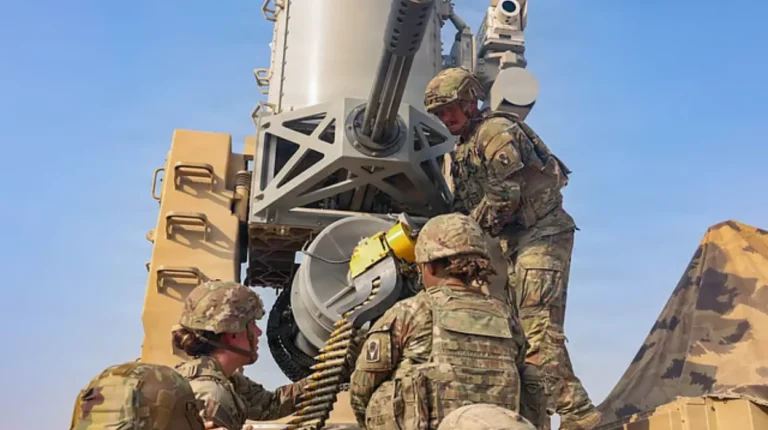
South Korea and the United States will conduct their major annual Ulchi Freedom Shield military exercise from August 17 to 27, as the allies adjust their defence planning to what officials describe as North Korea’s evolving military capabilities. The 11-day exercise will involve approximately 18,000 South Korean troops and will combine conventional military training with preparations for drone attacks, GPS disruption, cyberattacks and other forms of hybrid warfare.
The exercise comes at a particularly sensitive moment. North Korea resumed ballistic-missile testing on August 6, firing a short-range ballistic missile from the Wonsan area towards the sea.
The launch occurred less than two weeks before the start of the annual joint drills between the United States and South Korea, causing South Korea to enhance surveillance while cooperating with the United States and Japan. For Seoul and Washington, the Ulchi Freedom Shield drill is a defensive measure designed to deter the North and ensure a rapid reaction to any possible attack. However, for North Korea, the annual U.S.-South Korea joint drills have been seen as practice for the invasion or preemptive attack on North Korea.
The contrasting views have resulted in a familiar pattern on the Korean Peninsula, where the allies perform drills to show their readiness, and North Korea considers these drills provocative and often retaliates with missile launches or threatening military actions. But unlike previous years, the drill itself has changed due to a changing security environment, where drones, cyberattacks, electronic warfare, and battle experience from the cooperation of North Korea with Russia play an important role next to the nuclear weapons and ballistic missiles.
Training for a Wider Range of Threats
In 2026, the training exercise would test the ability of the allies to respond to North Korean drones, GPS disruption, and cyber-attacks. It will also analyze how military units function with disruptions of their communication, navigation, and command system. The reason why this emphasis is important is that contemporary wars start under the threshold of the full-fledged war. A military conflict may be associated with cyberattacks against governmental agencies, GPS jamming that impacts aircraft and missiles, use of drones, an attack on communication facilities, and disruption of civilian services prior to the mobilization of conventional forces. Ryan Donald, the public-affairs representative for the US military, noted that the allies were drawing experience from contemporary wars, including the war in Ukraine. North Korean soldiers who fought along with the Russian troops had the experience of modern combat with drones, electronic warfare, and constant changes of the command and control system.
Donald said the exercise was responding to the “changing character of war”, with the United States and South Korea preparing for a battlefield in which unmanned systems and electronic attacks could be as important as tanks, aircraft and artillery. The exercise will also support South Korean government emergency-readiness drills. This means the training is not limited to military units. It will test the government’s ability to maintain essential functions, coordinate emergency responses and sustain national leadership during a crisis involving missile strikes, cyberattacks or a broader armed conflict.
The U.S. Forces Korea exercise framework includes live, virtual, constructive and field-based training involving personnel from different military services. This structure allows the allies to train both physical combat operations and command decisions through simulated scenarios.
Missile Launch Raises Tensions
North Korea’s August 6 launch provided the immediate backdrop to the announcement of the new exercise. South Korea’s Joint Chiefs of Staff said the short-range ballistic missile was detected after being fired from near Wonsan at around 5 p.m. local time. South Korean forces subsequently increased surveillance and maintained close coordination with U.S. and Japanese authorities.
The launch was significant since it signified a return to weapons testing by North Korea following a lull in tests for over 40 days. While the short-range missile may lack the range of an intercontinental ballistic missile, such missiles are a key component of North Korea’s plan for intimidating South Korea and U.S. forces present in the peninsula. South Korea’s Presidential Office called an emergency security meeting where they decried the test firing as a provocative act in contravention of United Nations Security Council resolutions.
“Our military is maintaining the capability and readiness to respond overwhelmingly to any provocation,” the Joint Chiefs of Staff of South Korea declared. According to the U.S., the missile did not seem to pose an immediate danger to the lives of its nationals or any American territory or its allied nations. Nevertheless, the U.S. Pacific Command reiterated the resolve of the U.S. to defend its regional allies.
Seoul’s Defence Position
South Korea maintains that the annual exercises are necessary because the country remains technically at war with North Korea. The 1953 armistice ended active fighting but did not produce a permanent peace treaty. Seoul therefore considers combined military readiness with the United States essential to deterring aggression and managing a possible crisis.
South Korean officials also view the exercises as an opportunity to strengthen national resilience. A conflict on the peninsula would not be confined to military installations. Missile attacks, cyberoperations, disinformation, GPS interference and disruptions to transport, electricity and communications could affect the entire country.
The 18,000 South Korean troops expected to participate represent a substantial military commitment, although the figure does not include the entire South Korean armed forces or every U.S. personnel member involved in supporting the exercise. The United States has approximately 28,500 troops stationed in South Korea as part of its permanent alliance presence.
The exercise is also linked to South Korea’s long-term objective of assuming greater responsibility for wartime command. Under the current Combined Forces Command structure, a U.S. general serves as commander and a South Korean general as deputy commander. Seoul wants the transfer of wartime operational control, or OPCON, to a South Korean-led command, but the transition remains dependent on military conditions rather than a fixed political timetable.
UFS training helps assess whether South Korea can lead combined operations against a nuclear-armed North Korea while maintaining effective coordination with U.S. forces. It therefore has both an immediate deterrence purpose and a longer-term alliance-management function.
Washington’s Alliance Message
The drills are proof that the security commitment of the United States towards South Korea is not just symbolic but is functional. The United States troops that have been deployed on the peninsula offer military assets, intelligence, air force, missile defense, and command support to South Korea, which has a large conventional army. The argument put forth by the United States is that such exercises help in building up of inter-operability and minimize the chances of any misunderstandings arising out of the situation. The military units that are training together develop communication protocols, clarify their command responsibilities, and learn how to coordinate their actions before the time of crisis actually arrives. The other reason is that the United States is preparing itself against a North Korean military force that is technologically diversified.
A 2026 Congressional Research Service assessment said North Korea was “committed to expanding its strategic weapons programs, including missiles and nuclear warheads” in order to consolidate its deterrent capability. That assessment reinforces the allies’ argument that routine military readiness remains necessary even when no immediate crisis is visible.
Pyongyang’s Rejection
North Korea rejects the U.S. and South Korean description of the drills as defensive. Pyongyang argues that the exercises rehearse the occupation of North Korea and are evidence of a hostile policy by Washington and Seoul. During the March 2026 Freedom Shield exercise, Kim Yo Jong, the influential sister of North Korean leader Kim Jong Un, described the allied training as a “provocative and aggressive war rehearsal” and warned that it could damage regional stability.
She also said the exercises were not a harmless military activity but a preparation for confrontation.
In a statement reported during the March drills, Kim called them “not a ‘military game’ but provocative and aggressive war rehearsal of those simulating and planning the confrontation with the DPRK.”
The North Korean government has before characterized U.S.-South Korean military drills as the “will to invade,” and Pyongyang has vowed to respond to such actions in kind. The worry that the North will face with such military drills is not just the scale of the drill itself, but the chance that it may involve drills on how to deal with missile defense, counterforce action, leadership protection and a nuclear or chemical attack. The reaction of the North Koreans is also a result of the change in their attitude towards engaging with South Korea. The North has seen South Korea as a hostile country rather than one that can be united at some point in the future.
Russia Factor Changes Calculations
One of the major additions that have been made to the 2026 scenario is the mention of North Korean soldiers who have served alongside Russian forces in Ukraine. The involvement of the troops in a real war scenario has enabled the North Koreans to gain experience in warfare as well as understand the Russian approach towards battles. The war in Ukraine has proven how essential cheap drones, electronic jamming, satellite communication, cyber operations, and fast targeting have become in modern-day warfare. North Korea may learn some tricks from them to apply on the Korean Peninsula, where densely populated cities, mountains, and heavily fortified positions would provide a complex battlefield. Hence, the U.S. and South Korea are ready not only for a copy of the Korean War.
This does not mean that the exercise indicates an imminent offensive by North Korea or an intention by the allies to launch one. Rather, it reflects a shift in military planning from a narrowly conventional scenario to a multi-domain conflict involving military and civilian systems.
Deterrence and Escalation Risks
First and foremost, deterrence is the primary strategic goal of Ulchi Freedom Shield. By showing that South Korean and American forces can coordinate with each other, the drills are aimed at convincing the regime in North Korea that its aggression would result in a fast and powerful reaction. The problem, however, is that such demonstrations can also be perceived as preparations for regime change or decapitation attacks by Pyongyang. In order to show its strength and determination, North Korea might launch missiles, carry out artillery training, use satellites, engage in cyber operations or use other tools of provocation which are meant to prove that it will not be intimidated. The missile launch of August 6 is an example of such tactics. It was rather small-scale and apparently posed no threat to American territory, yet it happened at a politically significant moment and showed that Pyongyang has the capacity to cause instant tension while staying within the framework of non-violent actions. The task for South Korea is to remain prepared to act while preventing routine drills from becoming an uncontrollable escalation cycle.