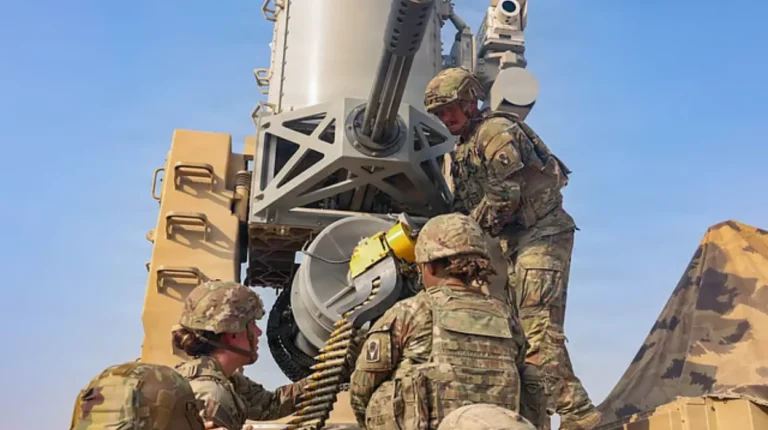
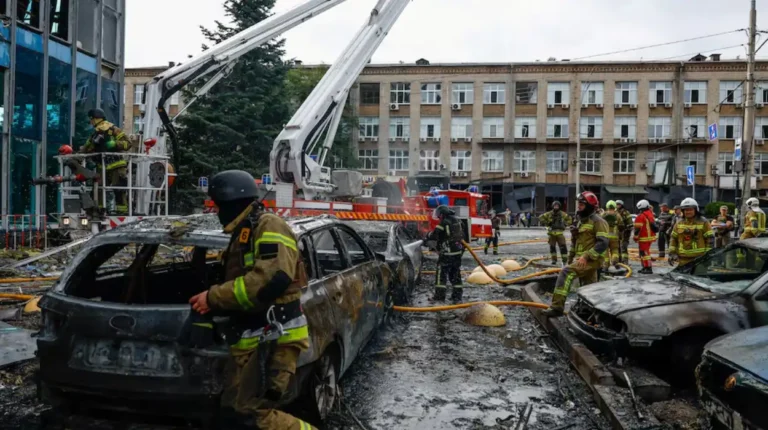
Russia has warned Britain that it will face “consequences” after reports that Ukrainian forces used drones manufactured by British companies to attack military and industrial targets deep inside mainland Russia. The warning has intensified an already dangerous confrontation between Moscow and London, while highlighting the growing reach of Ukraine’s long-range strike campaign and the increasingly direct role of Western-made weapons in the war.
The attacks mentioned above are important since, according to Russia, it is the first case of attacks against the officially recognized territory of Russia using British-made drones. Even though Britain has sent Ukraine substantial amounts of military equipment, which included long-range strike drones, the attacks have not been officially confirmed by London and, what is more, there are no facts about the involvement of any British personnel in the selection of targets. However, Russia regards these attacks as proof that Britain does not support Ukraine but takes part in attacks against Russian territories indirectly. The Embassy of Russia in the United Kingdom accuses Britain of deliberately intensifying the war, saying that the more Britain gets involved, the bigger price it will have to pay.
Russia issues warning to Britain
The Russian warning followed reports that drones produced by two British companies had been deployed by Ukraine in a campaign of deep strikes inside Russian territory. The attacks reportedly targeted oil refineries, military facilities, logistics hubs, fuel infrastructure and other sites regarded by Kyiv as supporting Russia’s war effort.
In a statement reported by British and international media, the Russian Embassy in London accused Britain of
“deliberately opting for an escalation of the Ukraine crisis.”
The embassy also alleged that London had become
“an accomplice and co-perpetrator of the bloody crimes and terrorist attacks,”
language designed to frame British military assistance as direct participation in hostilities.
The embassy warned that
“London’s actions will inevitably carry consequences for which it will have to answer.”
It added:
“The deeper its involvement in the conflict and the greater its support for Kyiv’s terrorist machinery, the higher the price it will pay.”
What those consequences may be was not spelled out by Moscow. This is an important element of the message being sent. It enables Russia to threaten countermeasures without having to outline what those may be in terms of specific diplomatic, cyber, military or covert actions. It also continues the trend of Russia sending such messages since the start of the invasion. The Russians have warned time and again Western governments that arming Ukraine with state-of-the-art weaponry may be crossing a red line. This has been coupled with allegations from Moscow of the US, UK and Europe waging a proxy war against Russia.
Britain rejects Moscow’s accusation
Britain has rejected the suggestion that it is directly conducting strikes against Russia. The UK Ministry of Defence said London remained committed to providing Ukraine with the equipment needed to defend itself against Russia’s invasion.
A Ministry of Defence spokesperson said:
“Britain stands shoulder to shoulder with Ukraine and we are committed to providing the equipment Ukraine needs to defend itself against Putin’s illegal invasion.”
The spokesperson added:
“Russia should be in no doubt about the resolve of this government to stand against Russian aggression, in Ukraine and against the UK and our allies.”
The British argument is based on the idea that while they are providing weapons to Ukraine, they have no say in the way they use them. As a result, Ukraine should be considered to bear all responsibility regarding the decision on the ways those weapons provided by the British are used. However, Russia does not agree with such an argument. For them, it means that weapons, intelligence, training and technical assistance provided by Western countries allow them to participate in attacks launched from Ukraine. The official view of the Russian government is that British assistance to Ukraine has become offensive because the weapons provided by the UK can strike targets located several hundred or thousand kilometres into the territory of Russia.
Britain’s expanding drone support
In April, Britain announced what it described as its largest drone package for Ukraine since the beginning of the war. The package initially included more than 120,000 drones for delivery during 2026.
The British Ministry of Defence said the support would include long-range strike drones, surveillance systems, logistics drones and maritime platforms. Many of the systems were expected to be manufactured by British companies or developed with British defence-industry participation.
In June, Britain increased its planned drone commitment to 150,000 systems by the end of 2026. The wider military package was valued at approximately £752 million, or about $996 million, and also included more than 350 air-defence missiles and radars.
The sheer size of the commitment reveals how quickly drones have become crucial to Britain’s military assistance program. Instead of sticking with conventional missiles which are costly, Ukraine is receiving a huge number of unmanned aircraft which are relatively cheap and can be used for reconnaissance, attacks with precision, logistics, and saturation operations. The UK government also supports developing strike missions at long ranges. One of the projects by the UK involves a deep-strike weapon which is claimed to carry 200 kilograms of warheads over a distance of 500 kilometers.
Another system designed in the UK is said to target beyond 500 kilometers and carry warheads of about 225 kilograms. Therefore, the recent use of British-made drones in Russia should be seen as part of a larger strategy instead of an isolated event. Ukraine is attempting to damage Russia’s industrial-military complex, its supply of fuel, logistics systems and forces it to provide defenses over a large area.
What the reported attacks targeted
The reported British-made drone operations are said to have formed part of a campaign lasting approximately six months. According to media reports, the drones were used against Russian military and industrial targets, including oil-refining facilities in the Yaroslavl and Volgograd regions.
The attacks reportedly also affected fuel depots, military bases, logistics hubs and warehouses. One prominent case involved facilities associated with Wildberries, Russia’s largest online retailer. Ukrainian officials have argued that some commercial logistics infrastructure can be used to support military procurement and supply chains.
Ukraine claims that it succeeded in disabling seven out of the ten largest logistics centers of Wildberries. These claims have not been independently verified, and it is hard to measure the operational impact of such strikes based on public data. However, the attack is raising fears in Moscow as it undermines Russia’s belief in security of its mainland due to the distance from Ukraine. From the beginning of the full-scale war, Russia has relied on its vastness to hide its industrial and military installations from being targeted with weapons of Ukraine. Long-range drones significantly lessen the protective effect of distance. Furthermore, the economic impacts are also a part of this strategy. According to the BBC, the strike campaign is estimated to have caused the economic damage of more than £35 billion. This number should be interpreted with caution as it is based on reports and not an independent assessment from any international watchdog.
A growing Ukrainian deep-strike campaign
The British-drone reports emerged as Ukraine intensified attacks across Russia. Russian officials cited by the BBC said Ukraine had launched approximately 822 drones during one major overnight operation. Around 600 drones were reportedly directed towards Moscow and surrounding areas.
Russia’s Defence Ministry said it intercepted or destroyed 598 Ukrainian drones over 19 Russian regions, as well as over the Black Sea, the Sea of Azov and occupied Crimea. Russian officials also reported deaths, injuries and damage to buildings, including a Wildberries warehouse.
One attack alone is claimed to have resulted in the death of nine and injury of 23, which included a child. These numbers are provided by the Russian government and have yet to be independently verified. While Ukraine insists that their attacks target only the military and supporting military targets, Russia has accused Kyiv of perpetrating terrorist attacks against civilians. The size of the attacks clearly indicates that Ukraine is now engaging in attacks using drone swarms as opposed to individual attacks. In the event of a swarm, the number of attacks could easily overwhelm air-defence systems, forcing the Russians to use up interceptors and redeploy defence forces. Data provided by conflict monitoring services, as seen in The Guardian report, showed that Ukraine carried out three times more long-range attacks in July compared to January.
For Ukraine, deep strikes offer several strategic advantages. They can disrupt Russian fuel production, interfere with troop movements, damage weapons factories and force Russia to divert resources from the battlefield to homeland defence. They may also create political pressure by demonstrating that the war is reaching areas previously considered secure.
The legal and political distinction
The dispute raises difficult questions about the difference between arms supply and direct participation in warfare. Britain is supplying equipment, but public evidence does not establish that British forces commanded or carried out the reported strikes.
The available reports indicate that Ukrainian forces operated the drones. They do not demonstrate that British personnel selected the targets, controlled the aircraft or authorised the attacks. That distinction is important politically and legally, even if Moscow considers it artificial.
The legality of each individual strike depends on the nature of the target, the expected civilian harm and the precautions taken by the attacking force. Military objectives may lawfully be attacked during an armed conflict, but attacks must comply with the principles of distinction, proportionality and precaution.
The presence of civilian infrastructure does not automatically make a site a protected civilian object if it is being used for military purposes. At the same time, a commercial warehouse, refinery or energy facility cannot lawfully be targeted simply because it is economically important. Determining the status of each target would require detailed evidence that is not currently available.
This uncertainty is particularly important in relation to the reported strikes on logistics and retail infrastructure. Ukraine says such sites may contribute to Russia’s military supply system. Russia presents them as attacks on civilian economic facilities. Independent verification is needed before definitive conclusions can be drawn.
What could Moscow do next?
Russia’s warning could be followed by diplomatic retaliation. Moscow might expel British diplomats, impose additional restrictions on the British Embassy or summon the UK ambassador for a formal protest.
A possible retaliatory action could involve cyber or intelligence-related means. In particular, there might be more Russian cyber attacks on British defense industries, government bodies, and transportation and critical infrastructures. There could be more covert activities by Russia targeting European defense supply lines. Yet another possible option for Russia would be to use a military counteraction aimed at destroying Ukrainian production and logistic capacities. Russia could try to destroy installations related to manufacturing, assembling, storing or launching long-range drones.
It could attack installations connected with Western support to Ukrainian troops. Russia might continue its attacks on Ukrainian cities and power stations in order to show that a deeper Ukrainian strike would lead to higher costs for Russia. The risk of a retaliatory action would be high because it could lead to more civilian deaths and escalate the conflict even further. The most dangerous scenario would be a direct attack on British or NATO-related facilities outside Ukraine which would turn a tense confrontation into a crisis between Russia and the alliance.
A new phase in the war
The deployment of British-manufactured drones in Russia exemplifies the evolving nature of the war. The battlefront is no longer characterized solely by artillery bombardments and trench warfare on the frontline. On the contrary, it encompasses attacks with increasing range on energy, industrial, military and logistical infrastructure far from the frontline. From the British perspective, the policy dilemma is to assist Ukraine in developing its defences without giving the impression of direct participation of the UK in attacks on Russia.
From the Ukrainian point of view, the challenge is to employ deep strike capabilities effectively but without causing civilian damage that would harm its reputation and alienate international support. For Russia, the attacks demonstrate a major vulnerability. The Russian leadership needs to protect a vast territory from ever more sophisticated drone strikes while carrying out its own missile and drone strikes on Ukraine. Every air defence system deployed for the protection of an oil refinery or a logistics hub is one less system deployed at the frontline. In other words, the immediate controversy between Britain and Russia is not about one drone unit. It is a showdown about the extent of military assistance from the West, red lines of Russia and deep strikes of Ukraine.
Russia’s threat of “consequences” is intended to deter Britain from expanding its support. Britain’s response shows that London does not intend to retreat. Unless diplomatic efforts reduce tensions, the reported strikes may become another step in a cycle in which Ukrainian attacks deepen, British assistance expands and Russia responds with increasingly severe warnings and retaliation.