The U.S. military’s use of a high-energy laser to destroy three Mexican cartel drones near the southern border is more than a tactical counter-drone success; it is a signal that Washington is willing to deploy directed-energy weapons operationally against non-state actors in a domestic security context. Coming after years of experimentation, legal debates, and limited field tests, this incident crystallizes a shift from “counter-drone trials” to “counter-drone operations” along one of the world’s most scrutinized frontiers.
A Laser Engagement That Changes the Calculus
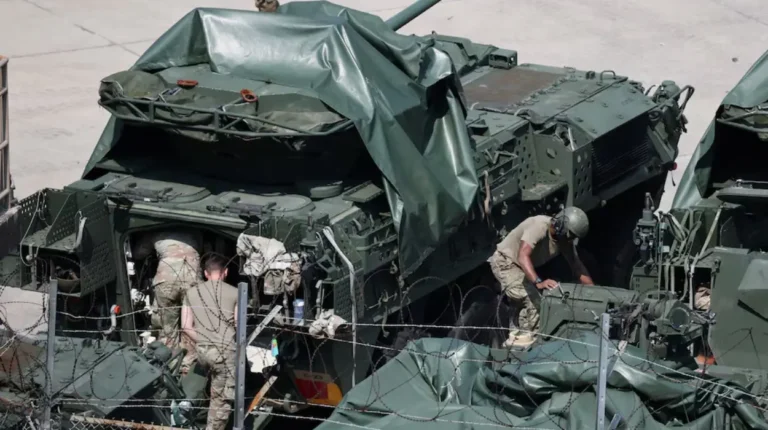
On Tuesday night through Wednesday morning, U.S. troops in the Rio Grande Valley of South Texas used an Army Multipurpose High Energy Laser on three unmanned aircraft systems (UAS) operated by the Mexican cartels, taking them out of the air. This incident was carried out by the U.S. military’s Joint Task Force for the southern border, operating under USNORTHCOM, with assistance from NORAD, and was portrayed by officials as a defensive action against hostile surveillance endangering U.S. forces.
The uniqueness of this engagement, however, lies not only in the weapon itself, but in the operational context in which it took place. Directed energy weapons have long been heralded as the ideal response to the increasingly prevalent threat of drones; cheap, precise, and scalable, they promise to solve what might otherwise be a difficult problem. However, employing directed energy in this manner – against cartel-operated drones in a border context – moves them out of the realm of proof of concept and into the realm of operational rules of engagement. USNORTHCOM and NORAD called the drones “hostile” because they were “in support of activities posing a physical threat to U.S. military personnel” and “U.S. Customs and Border Protection,” the two organizations stated.
The Technology Behind the Strike
The system employed was identified as an Army Multipurpose High Energy Laser, a directed-energy weapon designed to disable or destroy small drones by focusing intense energy on critical components until they fail. Unlike kinetic interceptors, which rely on missiles or gunfire, lasers offer near-instant engagement, low per-shot cost, and deep magazines limited mainly by power and cooling.
The Army is not the first to deploy systems like these near the border. As recently as February 2026, a 20 kilowatt laser counter drone system (LOCUST) was employed near El Paso International Airport, which resulted in an airspace shutdown for 7 hours because of problems with coordinating airspace. This particular incident led to the tightening of the civil-military procedures and demonstrated the challenges associated with conducting operations using high-energy beams in airspace shared by civilian and military assets.
Since this point, the Pentagon has stepped up testing and deployment of high energy laser and high power microwave systems, with the top Army leaders announcing that an operational test of the systems in question against enemy drones will last a year. The Rio Grande Valley operation can become the first publicly known application of the Army high energy laser for counter cartel operations in domestic airspace.
Why Cartel Drones Are a Strategic Problem
U.S. officials have warned for years that Mexican cartels are no longer just smuggling drugs and people; they are building air capabilities that complicate border security. Drones are used for reconnaissance of patrol routes, monitoring of law enforcement movements, and coordination of smuggling operations. In some cases, particularly with the Jalisco New Generation Cartel (CJNG), drones have been weaponized inside Mexico to attack rivals, security forces, and civilians.
As mentioned in his testimony before Congress in July 2024, Steven Willoughby, the deputy director of the counter-drone initiative at the Department of Homeland Security, stated that
“cartels from Mexico employ drones nearly every day in order to smuggle drugs into the country and spy on border patrol agents.”
This level of regularity explains why Washington considers even small commercial drones as an ongoing high tempo threat rather than occasional problem. It is illustrated by several recent operations in Mexico. In late August 2026, for example, as part of a large-scale CJNG-related crackdown, law enforcement seized weapons, drugs, and “a drone and a drone inhibitor” along with other things.
The Border as a Directed-Energy Testbed
The southern border has effectively become a live-fire laboratory for U.S. counter-drone doctrine. After the February 2026 LOCUST episode, authorities refined coordination procedures with the FAA and clarified when and how directed-energy systems could be used in domestic airspace. The Pentagon’s counter-drone task force has been preparing a “shoot-off” for directed-energy prototypes, with Army Brig. Gen. Matt Ross noting that a successful demonstration could lead to
“a purchase order that allows us to start building the production lines to get these systems into the field.”
That the lasers have worked effectively against the cartel drones is entirely in line with that narrative. It shows not only that the laser technology has been proven effective against simulated drone targets in a controlled environment but also that it is equally effective when deployed against live, illicit drones in a politically charged border region. Moreover, it also reinforces the idea of multi-layered countermeasures, including sensors that can detect threats, software that can identify them and directed energy weapons that can neutralize them, all coordinated from a centralized control room.
According to Maj. Gen. Curtis Taylor, commander of the southern border Joint Task Force,
“Cartel networks are increasingly employing unmanned aircraft systems to facilitate illicit human-smuggling and actively spy on our personnel and law enforcement partners.”
And he added,
“By integrating layered countermeasures alongside advanced directed-energy capabilities like this laser system, we have made it clear that we will not tolerate hostile surveillance.”
These comments are not merely operational summaries; they are doctrinal declarations. They send a clear message to the U.S. adversaries that the U.S. military considers them legitimate targets for kinetic or directed energy attacks.
Legal and Diplomatic Gray Zones
One of the most crucial details of the entire incident was the exact spot from where the laser guns shot at the Mexican cartel. U.S. authorities did not confirm whether the attacks were conducted in the U.S. or Mexican airspace, claiming concerns of operation security and conducting counter-cartel and counter-drone operations. When asked directly, the representative of USNORTHCOM stated to CBS News: “The shots were taken in coordination with all partners operating along the border.
Due to operational security reasons and ongoing counter cartel and counter drone operations, we do not have additional details to provide at this time.” The above information was intentionally released to avoid complications in terms of the sovereignty and consent of Mexico in this case, as well as the possibility to use U.S. military force to attack non-state actors in foreign countries according to international law. At the same time, denying that there was any impact on Mexican territory could be perceived as a lack of credibility of the entire scenario. It should also be noted that the incident occurred at the period of time when the U.S. has been discussing more aggressive approaches to combating cartels, including the previous information about covert drone campaigns involving the use of armed U.S. drones against cartel targets in Mexico. Such actions were quite politically sensitive in Mexico as they would be seen as the infringement of sovereignty..
The Broader Drone Arms Race in Latin America
This is a single event within the larger regional pattern of organized crime gangs in Latin America quickly turning to the use of drone technology, including pairing commercial drones with improvised explosive devices and employing sophisticated drones for surveillance. In Mexico, for example, the CJNG has established a specialized unit that uses drones. Other gangs have done the same, resulting in an informal air arms race between the cartels and state security agencies. U.S. agencies are taking measures that include lasers, electronic warfare and kinetic weapons against the cartels’ drones. The DHS counter-drone program, for example, has advocated for greater authority in detecting, tracking and mitigation of drones around critical infrastructure and border areas. At the same time, the Pentagon has created a task force to explore a range of options on directed-energy and microwave technology to craft a flexible toolkit for countering drones. The Rio Grande Valley case involving lasers clearly illustrates how far the United States is prepared to go to defeat the drones of the cartels within its own borders.