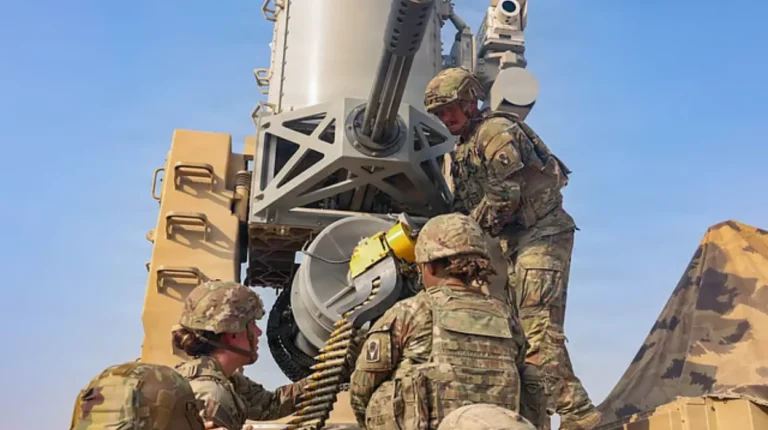
The latest escalation between Saudi Arabia and Yemen’s Houthi movement is beginning to reshape the security calculations of the wider Red Sea and Gulf region. As Houthi missile and drone attacks intensify against Saudi territory, Riyadh is turning increasingly towards regional and international partners for additional defensive support.
France has announced plans to send soldiers, radar equipment and air-defence systems to protect the strategic oil terminal at Yanbu, while Saudi Arabia, Pakistan and Turkiye are preparing an urgent meeting of their military chiefs under the newly established Mecca Joint Defence Agreement. Saudi Arabia has reported intercepting six ballistic missiles launched towards Taif and Yanbu, while the Houthis have claimed attacks against targets including Saudi Aramco facilities in Yanbu and a site in Riyadh.
The significance of these developments extends beyond the immediate exchange of missiles and drones. The Houthis have expanded their position along Yemen’s Red Sea coast and around the Bab al-Mandeb Strait, while Saudi Arabia is facing pressure on the infrastructure that allows it to move oil towards international markets. The result is an increasingly interconnected security challenge involving Yemen, Saudi Arabia, the Red Sea, the Gulf and the wider regional conflict involving Iran and its allies.
Saudi Arabia’s Defence Challenge Is Expanding
For Riyadh, the latest attacks represent a fundamentally different security problem from a conventional border confrontation.
The Houthis have demonstrated the ability to combine missile and drone attacks with territorial advances inside Yemen and pressure on maritime activity. Saudi authorities have reported attacks affecting areas including Mecca, Jeddah, Taif, Yanbu and Riyadh, forcing the kingdom to defend a geographically dispersed network of population centres and strategic infrastructure.
This places significant demands on Saudi Arabia’s air-defence architecture.
Protecting a capital city requires one form of defensive deployment. Protecting oil terminals, refineries, pipelines, ports and other economic infrastructure across a much larger area requires another. The challenge becomes more complicated when an adversary can launch relatively low-cost drones and missiles in repeated waves.
The issue is therefore not simply whether Saudi Arabia can intercept individual projectiles. It is whether the kingdom can sustain an effective defence against prolonged attacks while ensuring that its critical infrastructure continues operating.
Why Yanbu Has Become a Strategic Focus
The emphasis on Yanbu is particularly important.
The Red Sea port is a major Saudi crude export and refining centre and is connected to the kingdom’s oil-producing regions by the East-West Pipeline. The pipeline provides Saudi Arabia with an alternative route for transporting crude towards the Red Sea without relying entirely on the Strait of Hormuz.
That alternative has become increasingly valuable as security conditions around Hormuz have deteriorated.
The Houthis’ ability to threaten Yanbu therefore has implications beyond the physical security of one oil terminal. If the infrastructure becomes vulnerable to repeated attacks, Saudi Arabia’s ability to diversify export routes during a regional crisis is weakened.
This helps explain France’s decision to concentrate defensive assistance on Yanbu. French President Emmanuel Macron described the planned deployment as an effort to protect the site rather than enter the wider conflict.
The distinction is strategically significant. External powers can provide defensive capabilities without necessarily committing themselves to a broader offensive campaign against the Houthis.
The Red Sea Is Becoming a Wider Strategic Pressure Point
The Houthi advance along Yemen’s western coastline adds another dimension to the crisis.
The group has seized the port of Mocha and strategic islands and has strengthened its position around the Bab al-Mandeb Strait, a maritime chokepoint through which a substantial share of global trade normally passes. Yemeni officials have warned at the United Nations that Houthi control of the area could create wider economic consequences.
For Saudi Arabia, the geography is particularly sensitive.
The kingdom’s economic model depends heavily on the reliable movement of energy exports. Any sustained disruption affecting the Red Sea, Bab al-Mandeb or the alternative routes around the Gulf can increase the cost and complexity of transporting energy to international markets.
The Houthis therefore possess leverage that extends beyond their immediate military capabilities.
Control or disruption around a major maritime chokepoint can force governments and businesses to reconsider shipping routes, insurance costs, naval protection and energy logistics. Even without completely closing the waterway, sustained uncertainty can have economic effects.
The Mecca Defence Agreement Faces Its First Major Test
The emerging Saudi response is also significant because it is testing a new regional security arrangement.
Saudi Arabia, Pakistan and Turkiye signed the Mecca Joint Defence Agreement in August. The agreement establishes the principle that an attack against one member is treated as an attack against all three. The countries have subsequently begun developing mechanisms for deeper military cooperation.
The planned meeting of the three countries’ military chiefs is therefore more than a diplomatic response to the latest attacks. It provides an early indication of how the new defence framework could operate under actual security pressure.
However, the precise nature of any Pakistani or Turkish military involvement remains uncertain.
Both countries have broader diplomatic interests across the Middle East and have been involved in efforts to mediate regional conflicts. The agreement establishes a framework for collective defence, but its practical application in the current Houthi conflict still has to be determined.
That distinction will be important.
There is a considerable difference between intelligence sharing, air-defence cooperation, logistical assistance, training, military deployments and direct participation in combat operations. The coming discussions could help clarify how far the agreement extends in practice.
France’s Role Adds a European Dimension
France’s decision to provide military assets for the protection of Yanbu introduces another layer to Saudi Arabia’s emerging defence network.
The deployment of soldiers, radar systems and defensive equipment suggests that European involvement could focus on protecting critical infrastructure rather than conducting offensive operations against Houthi positions.
This approach could become increasingly important as regional governments seek to strengthen their defences without widening the conflict.
For France, protecting a major energy facility also has wider implications because disruption to Saudi oil exports can affect European energy markets. The decision therefore links European security interests with the protection of Gulf and Red Sea infrastructure.
The development also illustrates how the conflict is gradually moving beyond a Saudi-Houthi confrontation. External powers are being drawn into defensive roles because attacks on Saudi infrastructure can produce consequences far beyond the immediate battlefield.
The Iran Dimension Complicates the Crisis
The Houthi campaign cannot be separated from the wider regional confrontation involving Iran.
The Houthis are aligned with Iran, although the precise degree of Iranian operational control over their decisions remains contested. Iranian officials have denied directing Houthi military operations, while regional and Yemeni sources cited by Reuters have described Iranian involvement in the group’s recent advances.
This uncertainty matters because the strategic implications differ depending on how independently the Houthis are operating.
If the group is acting largely according to its own calculations, the escalation demonstrates the growing ability of a non-state actor to independently influence regional security and energy flows.
If Iranian support is playing a more direct operational role, the Houthi campaign becomes another pressure point in the broader confrontation between Iran and its regional opponents.
Either way, Saudi Arabia faces a security environment in which threats can emerge through multiple interconnected theatres rather than from a single conventional adversary.
Economic Pressure Could Become as Important as Military Pressure
The protection of Saudi oil infrastructure highlights the economic dimension of the conflict.
Saudi Arabia is the world’s leading oil exporter, and the security of its export infrastructure has consequences for global energy markets. The recent Houthi attacks have already contributed to concerns about supply disruption, while Brent crude moved above $108 a barrel before easing.
The significance of this development lies in the interaction between several vulnerabilities.
The Strait of Hormuz remains exposed to disruption because of the wider Iran conflict, while the Houthis have increased pressure around Bab al-Mandeb. At the same time, Saudi Arabia’s East-West Pipeline provides an important alternative route but has itself faced attacks and disruption.
This creates a difficult strategic environment in which multiple energy corridors are simultaneously exposed to security risks.
The issue is therefore no longer simply whether a particular oil facility can be defended. It is whether the wider network of routes connecting Saudi production to international markets can remain sufficiently resilient during a prolonged regional conflict.
Yemen Is Becoming a More Important Battlefield
The renewed Houthi pressure on Saudi Arabia is occurring alongside intensified fighting inside Yemen.
Recent clashes around the Kahboub Mountains and areas between Lahj and Taiz have resulted in significant casualties, while Houthi forces have sought to strengthen positions overlooking the Bab al-Mandeb Strait. More than 230,000 people have reportedly been displaced since the beginning of September, adding to the millions already internally displaced in Yemen.
This creates a difficult contradiction for regional actors.
Saudi Arabia and its partners have a direct interest in preventing the Houthis from consolidating control over strategically important territory. But increased military pressure inside Yemen also risks worsening the humanitarian crisis and generating further displacement.
The military geography and humanitarian consequences are therefore becoming increasingly difficult to separate.
The Strategic Balance Is Changing
The most important development may be the emergence of a broader security architecture around Saudi Arabia.
Riyadh is no longer responding to the Houthi threat solely through its own military capabilities. France is offering defensive support, while Pakistan and Turkiye are preparing discussions under a collective defence agreement. At the same time, Saudi Arabia continues to coordinate with the United States despite Washington not renewing direct military involvement in the current confrontation.
This suggests that Saudi Arabia is attempting to distribute the burden of regional security across several partnerships.
The approach could strengthen the kingdom’s defensive capacity, particularly around critical infrastructure. However, it also introduces new questions about coordination, command arrangements and the possibility of different partners having different thresholds for involvement.
The more countries become connected to Saudi Arabia’s security environment, the greater the potential deterrent effect may be. At the same time, any military incident involving one partner could create pressure on the others to respond.
The Broader Strategic Implications
The Houthi escalation is increasingly transforming the security environment around the Red Sea and Gulf from a series of separate conflicts into a connected regional system.
The immediate issue is Saudi Arabia’s ability to defend its cities, energy infrastructure and maritime routes. The longer-term question is whether the kingdom and its partners can establish a sufficiently resilient defensive network to prevent repeated Houthi attacks from disrupting energy exports and regional trade.
For the Houthis, control of territory near Bab al-Mandeb and the ability to threaten Saudi infrastructure provide strategic leverage that extends well beyond Yemen’s borders. For Saudi Arabia, the response is becoming increasingly multinational, linking its defence requirements to France, Pakistan, Turkiye and the United States.
The coming military discussions between Saudi Arabia, Pakistan and Turkiye will therefore be closely watched. They could provide an early indication of how the Mecca Joint Defence Agreement functions under pressure and whether Saudi Arabia’s emerging network of partnerships remains primarily defensive or develops into a more integrated regional security framework.
At the same time, the protection of Yanbu and other energy facilities will remain central. If attacks continue to threaten alternative oil-export routes while maritime pressure persists around Bab al-Mandeb and Hormuz, the consequences will extend beyond the Gulf and Red Sea to global energy markets.
The central strategic issue is consequently becoming one of resilience: whether Saudi Arabia and its partners can protect critical infrastructure and maritime routes without allowing the response to widen the conflict into an even broader regional confrontation.