Israel now finds itself confronted with an enemy threat which is increasingly adept at adapting to changing circumstances and which requires the Israeli military and defense industries to engage in a fast paced race to counter these developments. While once a problem primarily confined to rocket and border fire attacks, this new threat has evolved into one which is far more sophisticated in nature and involves stealth drones and precise attacks as well as rapidly escalating battle dynamics. Recent news coverage reveals that the Israelis are not approaching the problem from a purely tactical perspective. Rather, they have developed a two-pronged approach which involves both military actions against Hezbollah targets as well as improved detection and interception systems.
Hezbollah’s Evolving Battlefield Threat
The newest strength of Hezbollah, according to the story, is the employment of tiny, undetectable drones and more fluid attack strategy. The problem is that these new methods are being employed in a manner which makes them harder to detect by the standard Israeli air defense systems. This is important since, besides the interception of the numerous rockets fired, the problem lies in the detection of the smaller, harder-to-spot threats that can attack soldiers, border outposts, and infrastructure.
Israel’s defense industries are racing to stop Hezbollah’s deadly new fiber-optic drones – and some of the solutions sound like science fiction.
— Hananya Naftali (@HananyaNaftali) May 22, 2026
Among the technologies now being tested are electromagnetic systems designed to capture drones out of the sky, advanced interception… pic.twitter.com/f03QTuHV24
This evolution changes the entire security equation. A rocket barrage can often be measured in volume and intercepted through established layers of defense, but stealth drones and dispersed strike methods require quicker identification and faster decision-making. That is one reason why Israeli officials now appear to view Hezbollah less as a static militia firing from known positions and more as a fluid military network adapting on the fly.
The significance of that shift is strategic, not just tactical. If Hezbollah can repeatedly force Israel to react to smaller, more concealed threats, then the group can create pressure out of proportion to the cost of its own operations. That asymmetry is exactly what Israel’s military and technology planners are trying to close.
Israel’s Expanding Military Response
Israel’s operational answer has been direct and forceful. The reporting says the Israeli military has expanded air and ground attacks against Hezbollah targets, with Chief of Staff Lt. Gen. Eyal Zamir authorizing
“targeted ground operations and strikes”
as part of what he called a “prolonged operation”. That language is important because it signals not a short punitive raid, but a sustained campaign meant to shape Hezbollah’s capabilities over time.
Similarly, Israel has engaged in strikes both inside and outside of Beirut, including in the southern parts of the city, in reaction to Hezbollah attacks in the north of Israel. As the case is presented in the reporting, officials in Israel justify the use of these strikes as retaliatory and defensive measures, claiming that the attacks conducted by Hezbollah violate the security agreement and pose a danger to Israeli populations near the border. The Israeli military operations are thus justified not only as punishment but as an attempt to pre-empt further attacks from Hezbollah by preventing them from continuing their attacks. In particular, the Israeli Defense Minister Israel Katz has demanded to destroy the crossings of the Litani River and to demolish houses in the border villages in order to eliminate threats for Israeli settlements.
The Tech Race Behind the Front
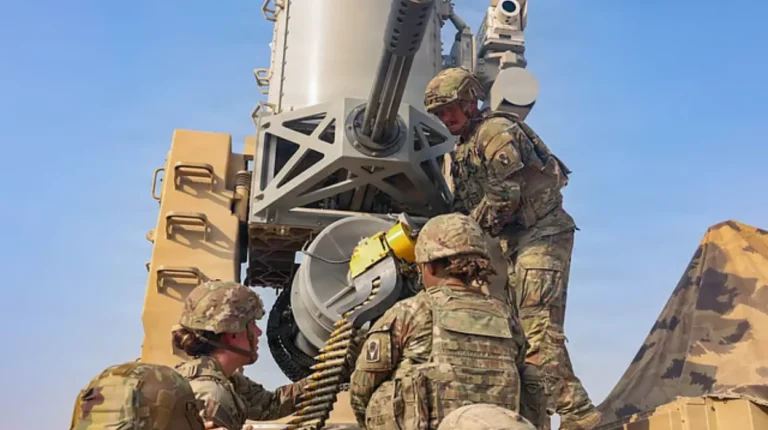
The second part of Israel’s response is less visible but just as important. The country’s military and defense-tech ecosystem is being pressed to improve how it detects, classifies, tracks, and intercepts threats that are smaller and more elusive than traditional missiles. The reporting does not name a new flagship system, but the direction is clear: the challenge posed by Hezbollah’s stealth drones is accelerating investment and urgency across Israel’s sensor, electronic warfare, and command-and-control landscape.
This is important because the success of drone defense is largely decided even before the engagement occurs. If the target appears late in the process, then there is less time for the defense system to respond, costs are increased, and the likelihood of hitting the target successfully is enhanced. From the perspective of the Israel military, therefore, survivability on the battlefield is not just dependent on their own interceptors, but on the ability of their technology networks to build a picture of the situation early enough. This is where military and technological concerns overlap. While the military may launch the missiles, it is the entire defense-tech chain that decides whether they will see the target or not.
Israel’s Stated Position
Israel’s public stance in the reporting is that its strikes are defensive and designed to stop Hezbollah attacks on Israeli territory. The Israeli side argues that Hezbollah has continued to violate ceasefire expectations and that military action is necessary to protect northern Israel and border settlements. That framing is central to Israel’s justification and remains consistent across the reporting.
A U.S. official quoted by Axios said the United States
“endorses Israel’s right to self-defense”
and that Hezbollah “must cease fire immediately”. The same report also says Israeli officials told Washington that Hezbollah’s attacks breach the ceasefire and justify Israeli action. Another U.S. official said Hezbollah faces a choice between continuing what he described as a “futile war” or allowing displaced civilians to return and Lebanon to rebuild.
These statements matter because they place Israel’s campaign in the broader diplomatic context. Israel is not just defending a border; it is operating inside a regional framework where U.S. backing, ceasefire language, and the return of displaced civilians all influence how the military escalation is interpreted.
Hezbollah’s Position and Regional Signaling
The narrative by Hezbollah, as conveyed by the media reports, is one of defiance and resistance. The militant organization has shown no signs of yielding to the political pressure that has been placed upon it, while its military conduct has indicated its readiness to retain power through the use of fire and adaptability. This adds to the difficulty of reducing tensions, as Hezbollah seems determined not to differentiate between the two.
There have been increasing regional signals from the Iranian side as well. Iranian officials and members of parliament have issued statements suggesting that American and Israeli assets in the region may be deemed legitimate targets if the conflict spreads further. This is particularly significant in that it adds regional dynamics into the conflict and takes the focus away from being a purely bilateral issue between Israel and Lebanon. In other words, Hezbollah is not alone in its struggle; it is functioning as part of an overall deterrent and retaliation axis where every attack by Israel can be seen through the lens of Iran’s regional policies.
Battlefield Figures and Reported Facts
The reporting provides several concrete details that help define the scale of the current situation. Israeli strikes on Beirut’s southern suburbs reportedly hit a Hezbollah command facility in Dahieh, with Lebanon’s state news agency reporting at least two people killed and about a dozen injured. Israel’s military posture has also included targeted ground operations and strikes, authorized as part of a prolonged campaign.
The Litani River is another geographical boundary which emerges as an important one in the reports, with Israel demanding that all crossings across the river be destroyed. This shows the significance of the region in terms of the control of movement, logistics, and possible Hezbollah entry points. The use of “small stealth drones” by Hezbollah against Israeli troops is another piece of information mentioned in the reports, which reveals the nature of the threat being faced by Israel, and the reason for its countermeasures. It is clear from these facts that they are part of a larger battle where Israel wants to restrict Hezbollah’s movements and capabilities.
Why the Stakes Are Rising
The real danger for Israel is that Hezbollah’s lower-cost, harder-to-detect weapons can force a disproportionately expensive response. Every drone that penetrates air defenses or every missile that triggers a major strike creates pressure not only militarily, but politically and diplomatically. That is why the contest is increasingly about speed, detection, and precision rather than simply firepower.
To the defense industry, however, this is a real-life test of the rapid response capabilities of Israel under the conditions of warfare. If these systems prove successful, then losses for Israel will be minimal, while Hezbollah will be kept guessing. Should they fail, however, the threat will be even harder to manage, resulting in a shift towards the protracted war of attrition. Overall, this means that Israel’s military operation and technology race cannot be separated from one another anymore. While strikes may address immediate threats, only sensing and interception will keep up with the changing tactics of the adversary.
Strategic Outlook
The most important takeaway from the current reporting is that the conflict has moved into a new phase of adaptation. Hezbollah is using stealthier and more flexible tools, while Israel is responding with an integrated approach that combines battlefield force and technological acceleration. That race is likely to define the next stage of the confrontation more than any single strike or statement.
The Israeli leadership has indicated that they are ready for a long-term campaign rather than a short burst. For Hezbollah, it seems clear that they will continue to exert pressure and retain their ability to attack. This all takes place against the backdrop of a rapidly developing contest between the technologies of offense and defense that could determine not only the battleground in Lebanon but also the entire regional security situation. This means that the front lines on the battlefield and on the technology front have converged. Israel must outwit Hezbollah, outdetect Hezbollah, and be ready for whatever happens next.