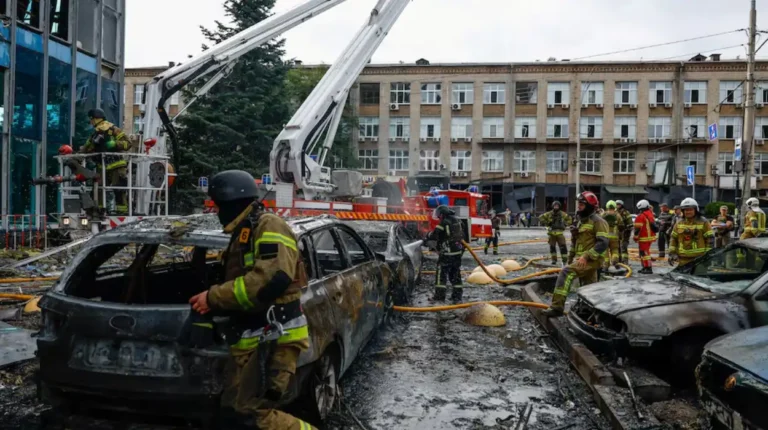
Ukraine says Russia used North Korean ballistic missiles in an overnight attack on the southeastern city of Zaporizhzhia, marking the latest escalation in Moscow’s military cooperation with Pyongyang. Ukrainian President Volodymyr Zelenskyy said the barrage killed six people in Zaporizhzhia and wounded 19 others, while Russian attacks across Ukraine killed at least nine civilians and injured dozens.
There were mixed strikes from North Korean ballistic missiles, Russian Zircon missiles, guided air bombs, and drones. According to the reports by Ukrainian authorities, there have been attacks in the Zaporizhzhia infrastructure, which also damaged civilian and industrial infrastructure. Other attacks took place in Kyiv and various parts of the nation. Ukrainian officials confirmed that there have been fires, building damage, and essential service disruption.
According to President Zelenskyy, there have been attacks on the civilians in Zaporizhzhia. The attacks were made amid reports that Russia was getting a new batch of North Korean missiles and preparations for the deepening integration of North Korean military personnel in the territory of Russia. This means that the ties between Moscow and Pyongyang are not only limited to ammunition provision but are turning into a military cooperation.
“The city was struck with North Korean ballistic missiles, Zircons, and guided aerial bombs. It was a vicious attack, calculated to inflict maximum damage specifically on civilian infrastructure,” the Ukrainian president said.
For the first time in its history, Russia cannot wage war without reinforcements from North Korea. It is now preparing to deploy an additional North Korean contingent on its territory. It has also received additional ballistic missiles from North Korea. Everyone around the world…
— Volodymyr Zelenskyy / Володимир Зеленський (@ZelenskyyUa) August 10, 2026
The latest missile allegation
The exact figure of missiles launched in the recent attack by North Korea has yet to be confirmed. The authorities of Ukraine have failed to provide a comprehensive missile-to-missile account of the attack, while the results of investigation carried out by independent groups have not been announced. This is important because, in general, it has already been confirmed from the data collected during previous analyses of missile fragments and intelligence reports that Russia is using North Korean missiles during the current conflict. Nevertheless, the attribution of all of the missiles employed in the attack that took place on August 11 relies mainly on claims made by Ukrainian authorities and initial findings from the battlefront. According to Ukrainian officials, the missiles are of North Korean Hwasong-11 class, which is known in the West as the KN-23 and KN-24. They are short-range ballistic missiles that can change their trajectory in mid-air.
Zelenskyy has repeatedly warned that Russia is increasing its reliance on these weapons.
“Russia received a new batch of ballistic missiles from North Korea,”
he said on August 10, adding that Moscow was preparing to receive or deploy additional North Korean troops. The Ukrainian president has also argued that the growing flow of missiles, artillery ammunition and personnel shows that Russia is struggling to sustain its war independently.
“This is the first time in Russian history that they cannot wage war without supplies from North Korea,”
Zelenskyy said in remarks reported by Ukrainian media.
Moscow has not provided a detailed public response to the latest accusations. North Korea has also not publicly acknowledged that the missiles used in the Zaporizhzhia attack came from its stockpiles.
Evidence from earlier attacks
Despite the recent allegation which requires additional debris analysis, the earlier use of North Korean missiles by Russia has been verified. The first verified case was mentioned after the Russian missile attack in Kharkiv on January 2, 2024. The United States stated that missile debris collected in Ukraine had features of a North Korean ballistic missile. Later, the US Defense Intelligence Agency stated that the missile debris found in Ukraine was “almost certainly” North Korean short-range ballistic missile. In accordance with the DIA, its conclusion was based on publicly available imagery and the technical analysis of the debris collected after the attack on Kharkiv.
Thus,
“Russia used ballistic missiles produced in North Korea in its war against Ukraine,”
according to the agency, adding that
“missile debris has been detected in several regions of Ukraine.”
The same conclusions were made by the Ukrainian prosecution and security agencies. The Ukrainian Prosecutor General stated that according to scientific and technical examination, the missile launched at Kharkiv is a short-range missile produced in North Korea. Later, Ukrainian security officials claimed that Russia used more than 20 Hwasong-11 missiles against Ukrainian cities between December 2023 and February 2024.
The missiles have been linked to attacks in and around Kharkiv, Zaporizhzhia, Kyiv and other Ukrainian regions. In April 2025, Ukrainian officials said a North Korean missile struck a residential building in Kyiv, killing civilians. In July 2026, Ukraine again identified a missile used in the village of Radushne as North Korean. Zelenskyy said the Radushne strike killed five members of the same family.
“In Radushne, the Russians used a missile from North Korea for the first time in a long time – that is what preliminary data shows,”
he said after the attack.
The Radushne incident was significant because Ukrainian intelligence described it as Russia’s first known use of a North Korean missile in several months. The renewed use suggested that Russia had either received fresh supplies from Pyongyang or conserved part of its earlier stockpile for later operations.
North Korean missile unit in Russia
Ukraine has also claimed that a North Korean missile unit is being deployed inside Russia. According to Ukrainian military intelligence, the unit is operating or preparing to operate in western Russia, near the Ukrainian border. The reported formation could include six launchers, approximately 120 ballistic missiles and about 90 North Korean personnel. Ukraine believes the personnel may be attached to Russia’s 112th Missile Brigade or may provide technical, logistical and operational assistance.
It remains uncertain what role North Korean forces are playing. They could be engaged in missile maintenance, communications, targeting and training but not necessarily firing weapons. Also, it is unknown whether North Korean forces participated in the most recent strike. According to Reuters, Russia was expecting to get 120 North Korean missiles and a new shipment would consist of some 40 KN-23 and KN-24 missiles. As reported, information was provided by the Ukrainian officials who could not be reached for comment. This would be a sign of the change in the nature of cooperation between North Korea and Russia.
Previously, the involvement of North Korean forces consisted in providing ammunition and sending troops. The establishment of missile unit on Russian territory would mean the direct involvement in the use of North Korean strategic missiles. It could help North Korea to gain practical experience in the use of such weapons on the field. Russia could provide North Korea with information on the missile precision, target choice, air-defense efficiency and effects of various warhead configurations. In return, North Korea could provide Russia with additional weapons in the situation when Moscow is regularly striking Ukraine with missiles and drones.
Why KN-23 and KN-24 missiles matter
The KN-23 and KN-24 are particularly valuable to Russia because they combine ballistic speed with some ability to maneuver during flight. Their trajectory can change after launch, complicating Ukraine’s efforts to calculate an interception path. A KN-23 missile is reportedly capable of carrying a warhead weighing up to approximately one tonne. That payload gives the missile significant destructive power against apartment buildings, energy facilities, bridges and industrial sites.
At the same time, the missiles put additional strain on Ukraine’s anti-aircraft defenses. Tools like Patriot missiles are among the relatively few systems that Ukraine possesses which are capable of engaging some ballistic missiles. Each missile engagement uses up costly and scarce anti-aircraft munitions. Ukraine has often turned to Western governments requesting more Patriot batteries and interceptors. Kyiv stresses the special danger of Russia’s use of ballistic missiles in the sense that it is impossible for Ukraine to defend every single city and critical infrastructure with high-end anti-aircraft defense system. Therefore, this recent missile attack has two sides to it. On one side, it caused immediate civilian losses in Zaporizhzhia, but on another, it showed the strategic utility of North Korean military equipment – Russia can continue its intense strikes while making Ukraine burn scarce resources on defense.
A wider Russia–North Korea military alliance
The missiles are only one part of an expanding relationship between Moscow and Pyongyang. North Korea has supplied Russia with artillery shells, rockets and other military equipment, while North Korean troops have reportedly been deployed to support Russian operations.
A Multilateral Sanctions Monitoring Team report said Russian-flagged vessels transported between 4.2 million and 5.8 million rounds of North Korean ammunition between August 2023 and March 2025. The report also cited estimates that more than 20,000 containers of North Korean military material had been transferred to Russia since September 2023. The same monitoring effort reported that North Korea had supplied Russia with more than 100 ballistic missiles during 2024. Ukrainian and Western intelligence agencies have separately estimated that North Korea delivered approximately 150 ballistic missiles between late 2023 and August 2025.
North Korea also sent more than 11,000 troops to Russia in late 2024, according to the sanctions-monitoring report. Additional deployments were later reported. Zelenskyy has claimed that Moscow is seeking as many as 30,000 to 50,000 more North Korean personnel, although those figures remain Ukrainian intelligence estimates rather than independently verified totals.
The military relationship was formalized through the Russia–North Korea Comprehensive Strategic Partnership Treaty signed in June 2024. The agreement includes mutual-defense provisions and has created a political framework for expanded military cooperation.
Sanctions and international law
The transfer of the North Korean missile to Russia goes against the UN sanctions system, as reported by the Multilateral Sanctions Monitoring Team. The UN Security Council resolutions ban any missile or arms transfers to North Korea or any ballistic-missile cooperation, assistance, or technical help. This kind of relation is very important since Russia is one of the permanent members of the UN Security Council and has the right to veto any UN resolution or action. In March 2024, Moscow used its right to veto the UN Panel of Experts’ mandate to monitor the sanctions imposed on North Korea. Later, the Multilateral Sanctions Monitoring Team was formed by the participating UN member countries to keep track of the violations of the sanctions.
The cooperation also raises concerns about technology transfers in the opposite direction. Western governments and analysts suspect that Russia may be providing North Korea with military expertise, air-defense systems, electronic-warfare assistance and possibly technical support that could improve Pyongyang’s missile and satellite programs.