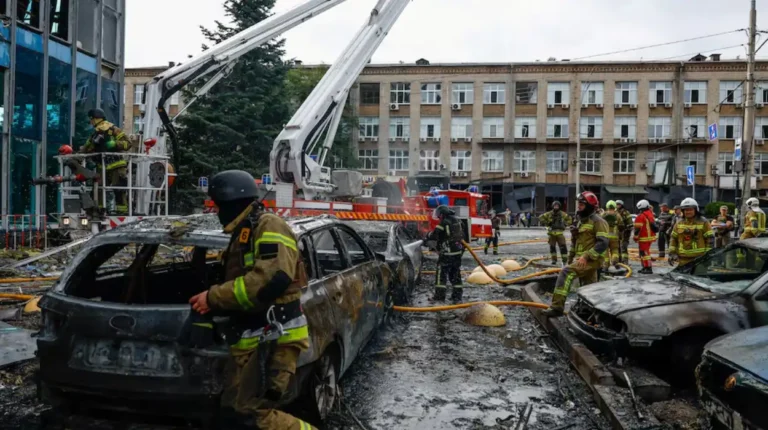
The March 22 incursion on Moscow’s Crocus City Hall concert venue by the terrorist body known as the Islamic State of Iraq and al-Sham–Khorasan (ISIS-K) has crushed the Russian people—twice. First, at least 139 people were massacred and hundreds wounded in the spray of gunfire and arson before the beginning of a sold-out show by the popular rock group Piknik.
The second victimization, which formed just as the fire was being put out, arrives in how the Russian people will be rejected the truth by Russian President Vladimir Putin’s government. The attack pounds at Putin’s claim to legitimacy as a strongman—so someone else has to be found to condemn: Ukraine, which the Ukrainian government, the US government, and others have expressed was not involved. Even ISIS-K’s quick affirmation of responsibility was obscured by the Russian people. On Monday, Putin finally admitted that “radical Islamists” were responsible—but he still falsely declared Ukraine was somehow ultimately responsible.
This deception has effects, most notably on the road not carried by Russia after Friday’s terrorist attack. Consider what a truly accountable Russian government would have done: It would have taken better safeguards after the early March warning from US intelligence that an invasion was imminent. It seems senior Russian officials, including Putin, de-emphasised the intelligence warning, perhaps believing it was part of a US conspiracy to disrupt Putin’s reelection. Even if the episode could not have been prevented, an accountable Russian government would now call for global solidarity and joint action against a lethal terrorist group responsible for thousands of deaths in Afghanistan, Pakistan, Iran, Russia, and elsewhere. A liable Russian government would convene a genuine accounting of its security failure to catch the plot and disrupt it.
And, of course, a responsible Russian state would not be embroiled in a dangerous war in Ukraine that may have left Moscow delighted, overstretched, and therefore powerless. Nor would a responsible Russian administration have launched the security crackdown (largely overlooked in the Western media, with some exceptions) against Central Asian employees that fueled grievances that may have permitted ISIS-K to recruit terrorist assassins among people already in Russia—though the facts at this time remain unclear.
It seems that the potential terrorist threat originating from Central Asia had become a blind spot of the Putin regime while it concentrated on pursuing political enemies in Russia and on dangers resulting from Putin’s invasion of Ukraine, including drone strikes and cross-border raids.
But Putin’s regime is not a responsible government, and the Russian people have the potential to be denied all these reasonable measures. This means the Russian people will persist in being vulnerable to prospective ISIS-K attacks, even after the security crackdown that is no doubt arriving inside Russia. Nor is there likely to be a shift of Russian support for the Taliban in Afghanistan, the Assad regime in Syria, or the government in Iran—all of which element into anti-Russian animus among Muslims in Central Asia and the Caucasus that ISIS-K operates for terrorist recruiting.
Russia’s attack against Ukraine and the return of great power rivalry to the world stage have not ended the danger of terrorism from ISIS-K and other terrorist groups. The point that they get less engagement in the Western press does not mean those dangers have vanished. Terrorism is still a threat that merits international cooperation, as the Biden administration directed by warning Russia of the threat in early March.
Russia’s intelligence oversight that made March 22 possible plays that terrorism’s danger is not past, even while Russia’s irresponsibility drives the world and its own citizens less secure.