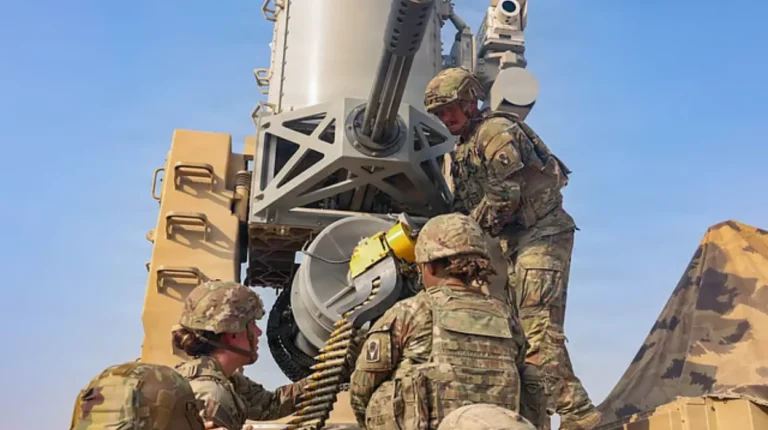
At the end of October this year, the Bison Counter 2021 kicked off. The European Defence Agency (EDA) supported multinational Counter-IED exercise hosted this year by the Italian Armed Forces in Sardinia, brings together teams from Europe and the US.
Bison Counter is today the largest and most relevant EU exercise of the C-IED community. The exercise’s objectives are to exchange and train technical skills, to integrate and use available technical enablers at a tactical level and to implement the full C-IED operational cycle with a view to improving interoperability and resilience among European states and allies.
The exercise scenario will be built up on a Crisis Management Operation (CMO) and spread around different locations. One of the key objectives is to increase responsiveness and operational readiness for EU crises management.
Research and technology activities are also integrated to the main lines of effort, seeking for close alignment between real operational requirements definition and the industry, technology and research institutes and organisations priorities.
The European Defence Agency (EDA) has been working on Counter-IED since 2007, fostering the capability development in identified shortfalls, as well as carefully considering its adequate integration into the Counter-IED overarching framework, covering the full range of enabler capabilities to achieve the desired end state: the mitigation of IEDs in the battlefield.
European strategic autonomy
“Strategic autonomy” describes the EU’s push to increase self-sufficiency and boost its own industry. “The strategic independence of Europe is our new common project for this century,” European Council President Charles Michel said last month. “European strategic autonomy is goal No. 1 for our generation.”
Proponents of greater strategic autonomy are calling for more coordination in defence, more joint capability development, more technologies and a stronger industrial base. Since coming into office in 2017, Emmanuel Macron has been the loudest advocate for the development of European strategic autonomy, describing it as the best way to revitalize NATO and address global challenges from the pandemic to arms control to climate change. France has worked closely with allies in the Mediterranean region in recent years. In September this year, France and Greece signed a landmark military agreement that provides mutual assistance in the event of one party coming under attack by a third country, even if the latter belongs to NATO. The agreement also includes a clause of mutual assistance in case of armed attack against the territory of one of the two.
The focus of strategic autonomy does not necessarily entail a decoupling from the United States. Rather, it focuses on increasing European capabilities. Europe is today confronted on its periphery with a certain number of conflicts and tensions in the Sahel, in Libya and in the Eastern Mediterranean, problems that do not primarily concern the United States. For many, the fall of Kabul served as a wake-up call. The rapid collapse of the Kabul government raised questions about the EU’s ability to drive its own defence policy. European countries had no option but to pull out of Afghanistan along with the US – despite their desire for Western troops to stay and stop the country falling into the Taliban’s hands. Washington’s NATO allies depended on US logistics and aerial support for their military engagement in Afghanistan – and then for the safe evacuation of their citizens.