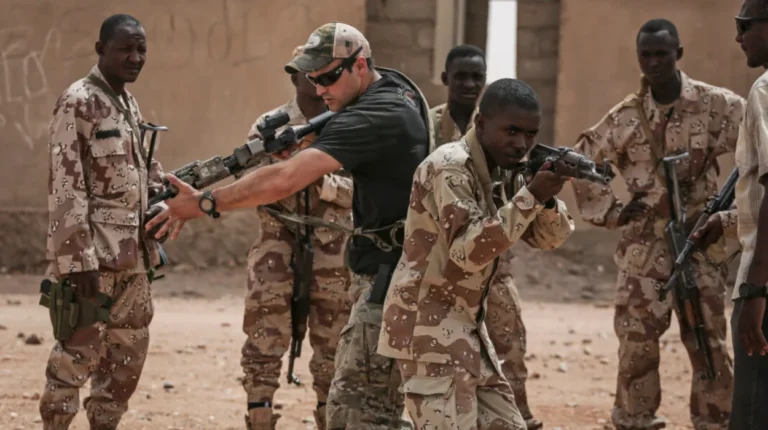
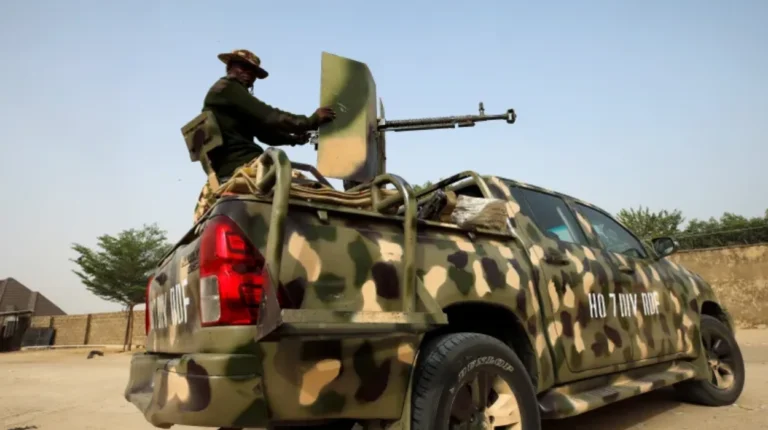
On May 4th, 2026, the Nigerian Army (NA) troops participating in Operation FANSAN YAMMA conducted coordinated security operations in various rural areas located within the Zamfara state. Specifically, two suspected terrorists were neutralized, and one AK-47, ammunition, and one motorcycle were also seized.
These operations took place throughout many rural parts of the Talata Mafara and Maradun Local Government Areas (LGAs), where both the Nigerian security agencies have sustained significant contacts with groups of armed bandits and Islamist-affiliated individuals taking advantage of the vast populations of ungoverned areas found within forested lands.
Context of Operation FANSAN YAMMA in the north‑west
Operation FANSAN YAMMA means “to clear an area”, which is the mission of Operation FANSAN YAMMA is the Nigerian Army’s primary campaign against terrorism and banditry in a number of Nigerian states: Zamfara, Kebbi, Sokoto, and a portion of Katsina. The operation is coordinated by the 8 Division / Sector 2, the Joint Task Force North-West, and consists of a combination of regular army units, air reconnaissance, elements of the Nigerian Police, and, in some situations, local vigilante groups.
The end state, as articulated many times by High Command, is to “clear” forested and rural enclaves of terrorist and bandit cells, restore state dominance, and reduce the mass killing of civilians, kidnappings, and highway attacks, which have been plaguing the region for over ten years. A senior officer has reported in an internal briefing that “Operation FANSAN YAMMA is achieving victory over terrorism in northwest Nigeria” and confirmed that the number of operations, and kills, reported has steadily increased in each quarter.
How this Zamfara operation fits into the wider pattern
The May 4 action in Zamfara is best understood as a tactical cell within that larger pattern. Intelligence sources indicate that the selected villages Maikwanuga, Aljumma, Gidan Dawa, Magami Didi, and Tungar Magaji have over recent months appeared on internal security lists as recurring staging grounds for raids against neighbouring communities. By the Army’s own account, troops moved into these areas at dawn, conducting clearance and ambush operations designed both to eliminate armed groups still present and to disrupt logistical routes used to ferry weapons, recruits, and hostage victims to and from deeper forest hideouts.
According to Defence Headquarters, the two individuals killed were positively identified via intelligence and during the course of the engagement as members of a terrorist network active in the axis.
The recovered AK‑47 rifle (registration number NE 3774), its magazine of 30 rounds, and the motorcycle are standard items in the arsenal of bandit and terrorist groups in the north‑west, often sourced from poorly guarded armouries, neighbouring conflict zones, or illicit cross‑border trade.
Statements, messaging, and official security‑theatre
The messaging around the Zamfara enclave sweep is carefully calibrated. The Nigerian Army portrays the event not as an isolated incident but as another incremental victory in a relentless campaign. In its own words, the operation is part of a broader strategy “to eliminate terrorists and bandits, restore security, and protect lives and property,” a script that has been repeated in relation to earlier high‑profile operations in the same theatre. The choice of verbs “neutralised” and “eliminated” is deliberate, conveying finality and control while sidestepping the more ambiguous language of captures or arrests that might invite questions about due process.
At the same time, the statement emphasises that the action was intelligence‑led, attributing the success to human and technical surveillance rather than random sweeps.
“Operations are based on actionable intelligence pointing to terrorist enclaves and movement in these areas,”
an Army spokesperson told journalists, reinforcing the image of a disciplined, modern force adapting to the complexities of asymmetric warfare. Linking this to broader FANSAN YAMMA outcomes
The May 4 operation in Zamfara must be read alongside other major milestones under Operation FANSAN YAMMA. In late 2025 and early 2026, the campaign earned national attention for the neutralisation of high‑profile kingpins, including Aminu Kanawa, described as Bello Turji’s second‑in‑command, and Sani Rusu, a notorious terrorist leader whose camps in the forests of Zamfara were reputedly responsible for multiple mass abductions and attacks.
Further, in raids on camps in Mahula, Kebbi, and other forested zones, the Army has reported the killing of scores of terrorists, the recovery of heavy weapons, and the freeing of dozens of hostages. One particularly notable operation in early 2026 saw 62 kidnap victims rescued in a coordinated sweep across Kebbi and Zamfara, with troops describing the camps as “well‑fortified” and “equipped with modern arms.”
Such operations are often accompanied by video footage released by the Defence Headquarters, showing captured weapons, destroyed structures, and rows of hostages being led to safety. These images serve a dual purpose: they reassure the public that the military is making progress, while also reinforcing the Army’s role as the primary arbiter of security in the north‑west.
Critical angles for terrorism and counter‑terrorism analysis
From the perspective of a thinktank dedicated to the critical examination of terrorism and counter‑terrorism, the Zamfara enclave sweep offers several analytical entry points. First, it exemplifies the securitisation of violence as terrorism, even when the lines between banditry, criminality, and ideology are blurred. The Army’s decision to label the two individuals as “terrorists” rather than ordinary bandits shapes both legal responses and public perception, potentially justifying the use of counter‑terrorism laws and military tribunals in contexts that might otherwise be handled through regular policing and criminal justice.
Second, the operation highlights the tactical preference for kinetic action over long‑term governance and development. The fact that the same forested enclaves targeted in May 2026 have been raided multiple times in previous campaigns suggests that temporary clearance does not equate to permanent control.
Without complementary investments in community policing, disarmament programmes, and alternative livelihoods for former combatants, there is a risk that these same areas will be reoccupied or repurposed as new hideouts.
Policy implications and the way forward
For policymakers and security planners, the key takeaway is that the Nigerian Army kills two terrorists line, however frequent it may appear in press releases, is only one fragment of a much larger picture.
Operation FANSAN YAMMA has altered the balance of risk for terrorist and bandit groups in the north‑west, forcing them to shift tactics, disperse their camps, and in some cases seek accord with local communities or authorities. Yet tactical victories cannot substitute for political resolution, especially where communal tensions, land disputes, and competition over resources remain unresolved.
In the meantime, the two terrorists killed in Zamfara on May 4, 2026, will be remembered officially as another small step in the Army’s campaign against terrorism.